
Unusual underwater robot creates a digital twin of the seabed at Gullmarn
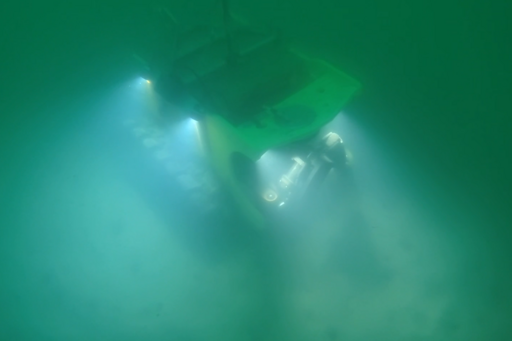
An unusual underwater robot is currently crawling back and forth on the seafloor of Gullmarn. It’s collecting data to improve our understanding of marine life – with a particular focus on the activities of Norway lobsters.
“There are very few remote-controlled robots of this kind in the world. One of them is in Gullmarn,” says Laurenz Thomsen, Professor of Marine Geology at the Department of Marine Sciences.
Gullmarn is a small – but very practical – test site within the European research project Digi4Eco. It's a specific area of the seabed where researchers collect marine data to build a so-called ‘digital twin’ of the ocean. With the help of the robot, they can observe the marine environment and collect unique data for the twin – all with the aim of improving our understanding of marine ecosystems.
“Comparable crawler-based observatory approaches have been deployed at only a handful of locations worldwide, including deep-sea observatories off Canada in 2010 shallow water deployments near Barcelona since 2025. What makes the robot particularly interesting is that it is connected to the internet and can be remotely controlled by researchers from all over the world. It really is unique,” says Prof. Laurenz Thomsen.
Creating a digital twin of the ocean
A ‘digital twin’ is a digital representation of a physical area and the various processes taking place there. The twin uses both real-time and historical data, but can also create models to simulate future scenarios, such as predicting how climate change and human activity might affect marine ecosystems.
With the help of all the data collected for the digital twin, researchers can, for example, increase our understanding of changes in the sea, carry out restoration work and also issue warnings about, for instance, local algal blooms.
“This will make it easier to protect the sea, but also easier to make more informed decisions on matters such as the siting of aquaculture farms, marine renewable energies, or potential deep sea mining activities,” says Prof. Laurenz Thomsen.
Shaping the seabed
A key area of research for the Kristineberg observatory is the behaviour and activity of the Norway lobster.
With the help of the robot, researchers can return to the same areas again and again to study the seabed and the behaviour of the Norway lobsters over a longer period. For example, when they leave their burrows, how they use – and change – the surrounding seabed, and how their activity varies over time.
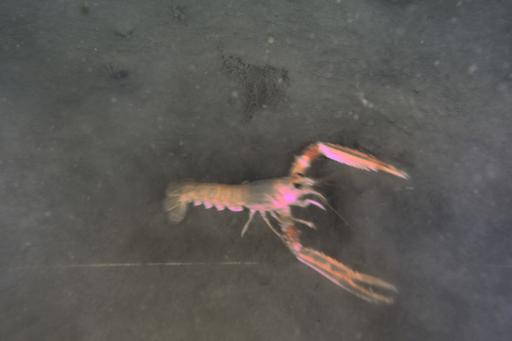
“The Norway lobster is an economically important species in European fisheries, but it also plays an important role in shaping the seabed. By digging extensive burrow systems, these animals create three-dimensional structures that can reach decimetres in height and may be important for the functioning of benthic ecosystems. Our observatory allows us to study how these structures develop and change over time.”
“Many of the areas we investigate are also regularly disturbed by bottom trawling. By comparing trawled and un-trawled areas, we aim to understand how biological activity and human disturbance affect seabed topography, sediment transport, and ecosystem functioning. Within the project are also developing a digital twin to monitor how elevated particle concentrations affect marine ecosystems,” says Prof. Laurenz Thomsen.
Writer: Annika Wall
