

Eric Hamrin Senorski’s research primarily focuses on injuries to the musculoskeletal system, including knee injuries such as anterior cruciate ligament (ACL), meniscus and other ligament injuries. The aim is to improve diagnostics, treatment and rehabilitation so that patients can regain function and return to sport with a reduced risk of further injury.
His research includes return to sport after ACL reconstruction, factors that influence the risk of new injuries, and how physical function can be assessed using different testing methods. He also investigates how patients themselves perceive their outcomes and how injuries to structures such as the meniscus and cartilage affect prognosis.
Personalised rehabilitation and a safer return

Why do some people recover quickly after a musculoskeletal injury, while others experience long-term problems or sustain another injury? This is one of the research questions Eric Hamrin Senorski is seeking to answer. In their research, he and his colleagues assess factors including strength, movement patterns, psychological well-being and patients’ own perceptions of their function.
“Essentially, I am trying to understand why two people with the same injury can have completely different outcomes. My research is therefore about finding the right treatment for the right person at the right time,” says Eric Hamrin Senorski, continuing:
“The goal is more personalised rehabilitation and a safer return to sport, work and physical activity.”
Sport showed the way
Eric Hamrin Senorski grew up in Gothenburg, with sport as a natural part of his life. Basketball eventually gave way to athletics and elite-level running for Örgryte IS, where he won three individual Swedish championship gold medals. His own injuries contributed to his interest in rehabilitation. But at home, there was also someone who recognised the need for a plan beyond the running track.
“My mother wisely thought that I also needed an education in case I didn’t become the best in the world. Of course, Mum was right.”
He chose to study physiotherapy at the University of Gothenburg. After graduating in 2013 and completing his master’s degree in 2015, he continued on a path towards patient-oriented clinical research.
“Sahlgrenska Academy was a natural choice because there is a strong tradition here of combining clinical practice with research. For me, it has always been important that research questions arise from real problems in healthcare and that the findings can then be translated back into benefits for patients.”
Eric Hamrin Senorski completed his PhD in 2018 and became an associate professor in 2021.
Finding the best treatment and using new technology for data analysis
A key question for Eric Hamrin Senorski and his research group at present is how best to treat different patients, including those who have sustained an ACL injury:
“Who will do well with rehabilitation alone, and who needs surgery? We are also working extensively on improving decisions about return to sport,” says Eric Hamrin Senorski, continuing:
“It is not enough simply to measure strength or look at how far someone can jump. We need to consider physical capacity, movement quality, psychological well-being, previous injuries and the demands of the particular sport together.”
The group also uses AI, machine learning and biomechanics to analyse clinical data and movement patterns. Together with researchers at Chalmers University of Technology and other collaborators, they are developing methods for analysing large volumes of clinical data as well as more detailed movement data.
“The idea is that this will provide a better basis for decision-making. The technology will not replace the assessment of the physiotherapist or physician.”
An expanding research environment
Since 2014, the research group has followed several thousand patients with musculoskeletal injuries.
“Our findings have helped us show that there is rarely a single test that can determine whether a person is ready to return to sport. Strength is therefore only one part of the picture. Confidence, movement patterns and factors such as generalised joint hypermobility may also play a role.”
Eric is particularly proud of the PhD students, early-career researchers and clinicians who have developed within the group:
“Seeing other people grow and achieve more than they initially thought possible is every bit as meaningful as any individual research finding.”
Students need to learn how to reason
In his teaching, Eric Hamrin Senorski wants to bridge the gap between theory and clinical reality. Students need not only to understand diagnoses and treatments, but also why a particular intervention is chosen and how it should be adapted to the individual patient.
“Evidence-based physiotherapy is about combining the best available research with clinical experience and the patient’s goals, circumstances and preferences.”
Looking ahead, he wants to develop teaching in a more interprofessional direction:
“I want students, clinicians and PhD students to be able to encounter physiotherapy, medicine, psychology, biomechanics and technological development within the same environment.”
Becoming a professor is not the end point
Eric Hamrin Senorski outside GoCo Active Lab in Mölndal, where a new sports medicine environment is taking shape, bringing together research, education, rehabilitation, biomechanics and technology.
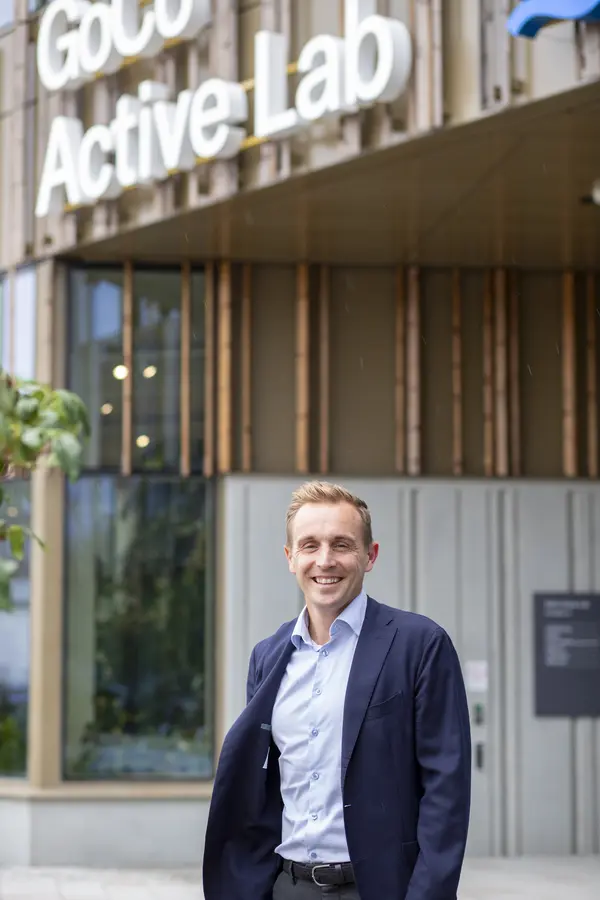
Eric Hamrin Senorski describes becoming a professor as an honour.
“The professorship is, of course, a personal recognition, but I also see it as the result of all the work we have done together within the research group and with our clinical and international collaborators. Above all, I am grateful to all the patients who have participated in our studies.”
Innovation is a contact sport
Research, supervision, teaching and clinical work will continue much as before for Eric Hamrin Senorski, but with greater responsibility for the research environment and early-career researchers. One important initiative is a new sports medicine environment with planned strength and movement laboratories, bringing together research, education, rehabilitation, biomechanics and technology. At the same time, Eric Hamrin Senorski wants to continue meeting patients and students.
“It is in those encounters that many of the most important research questions arise. Innovation is a contact sport.”
BY: JOSEFIN BERGENHOLTZ


