


MARSEL GANEYEV
Dissertation defense: 23 October 2025 (click for details)
Doctoral thesis: From percutaneous to transcutaneous hearing implants: Surgical techniques, osseointegration, and microbiological insights
Research area: Biomaterials
Sahlgrenska Academy, The Institute of Clinical Sciences
Hearing loss greatly affects quality of life. Bone conduction devices offer many patients a way to regain hearing, but the journey from surgery back to daily life is not always smooth. Pain, infections, and healing problems can occur, shaped by implant design, surgical technique, the body’s response, and the bacteria living on our skin.
“My dissertation looks at all these aspects to see how we can contribute to the development of next-generation implants and improve patient care,” says Marsel Ganeyev, researcher at the Institute of Clinical Sciences, who has conducted his doctoral work at the Department of Biomaterials and the bone-conduction hearing devices company, Oticon Medical AB.
Understanding complications
Marsel Ganeyev’s thesis is based on four studies. He examined retrieved implants to understand why patients experienced problems, studied bacteria around implants and how biofilms and antimicrobial resistance cause clinical problems. He has also tested how different drilling methods influence bone preservation, and evaluated new implant designs and surgical techniques for future transcutaneous systems.
“Our findings suggest that targeting biofilm-forming bacteria and analysing their antimicrobial resistance can improve treatment strategies and help prevent implant removals, which are most often caused by pain and infection. I also showed that simplified drilling techniques can reduce heat and potentially preserve bone,” he says and continues:
“When testing a new implant system, I explored less-invasive approaches for placing laser-modified transcutaneous implants. These insights can help refine surgical routines, guide the design of next-generation implants, and ultimately reduce complications for patients.”
Challenges and rewards in research
What has been enjoyable and challenging about your doctoral project?
“The most rewarding part has been working on a project that connects basic science with real patient care—seeing how findings in bone biology and microbiology can actually make a difference for people. I also really appreciated collaborating with clinicians, microbiologists, and engineers in such an interdisciplinary environment. The most challenging part was handling the complexity: bringing together clinical data, lab experiments, and technical methods, while also managing the depth and breadth of my research.”
Text: Jakob Lundberg
Full figure captions
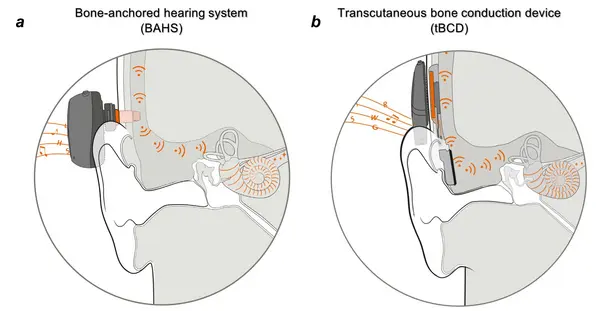
Figure 1: Bone-anchored hearing systems (BAHS) and transcutaneous bone conduction devices (tBCD). (a) Percutaneous BAHS, where vibrations generated in the external sound processor are transmitted directly to the skull bone through a skin-penetrating abutment; (b) Active tBCD, where the power and sound signal are transferred across intact skin via an inductive link to the implanted transducer.
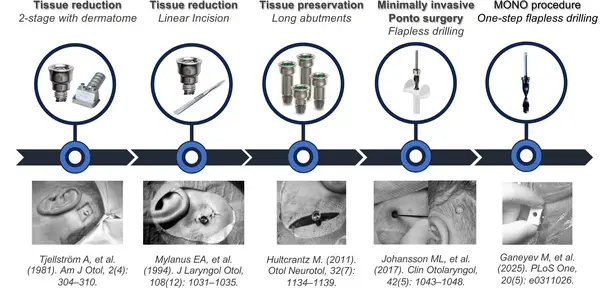
Figure 2: Key milestones in the development of surgical techniques for bone-anchored hearing implants, from early tissue-reduction approaches using dermatome and linear incisions to tissue-preservation methods with long abutments, minimally invasive flapless drilling (MIPS), and the most recent MONO single-step flapless procedure.


