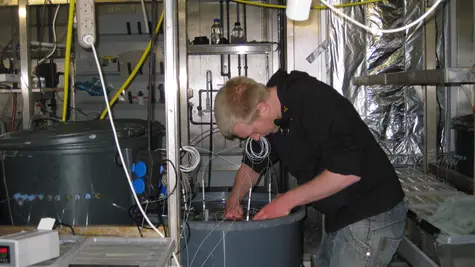
What happens when the fish eat?
The most important function of the gastrointestinal tract is the break´down and uptake of nutrients. For this to function properly, food needs to be transported along the gut at an well adjusted pace. Our focus is on the mechanisms that control gut motility.
Integrated control of gut motility
Gut motility refers to the coordinated movements - alternating contractions and relaxation - of the smooth muscles in the gastrointestinal tract. The movements are controlled mainly by the autonomic nervous system, especially the enteric part, but also by hormones. And other important player is the interstitial cells of Cajal (ICC).
What do we do?
We study for example:
- Characterization of enteric neurons with respect to neurotransmitters
- Occurrence and distribution of ICC in fish
- Motility patterns
- Effects of various neurotransmitters on gut motility
- Involvement of ICCs
- Effect of temperature and feeding on gut motility
To visualize nerve and other cells
With immunohistochemistry and other histochemical methods we can stain and visualize neurons and other cells in the gut. This gives both a general picture of how nerve fibres and cell bodies are distributed and what transmitter substance they contain.
Below is an example of how the enteric nervous system may look in fish.
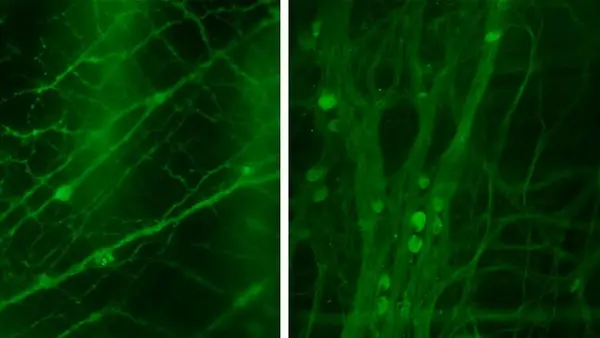
Foto: C. Olsson
To study motility
Gut movements and muscular activity can be studied by a variety of means, in vivo or in isolated tissue samples.Often we use a combination of methods to examine foe example the function of a specific transmitter or what happens after the fish has eaten or what temperature changes.
What happens when the water is getting hotter?
An important part of our research is to examine how motility and the various control mechanisms are affected when the surrounding waters are getting warmer. Increased body temperature means increased metabolism, and hence an increased energy expenditure making it even more important that digestion is optimized to meet the demands. But increased gut motility may cause a mismatch between transport and breakdown/uptake of food particles.
Recent publications
Check this review to find out more about the topic:
Olsson C, Gräns A & Brijs J (2025) Beyond ecology: the importance of gut motility in predicting the responses of species to climate change J Exp Biol
PhD theses from the group
"Gastrointestinal motility and blood flow in teleosts during digestion and osmoregulation"
Jeroen Brijs, 2017
"The effect of temperature on gut blood flow and gut motility in fish"
Albin Gräns, 2012
"Ontogeny of gut motility and the enteric nervous system in Danio rerio and Xenopus laevis"
Anna Holmberg, 2006