
Supervisor: Mats Hellström
Co-supervisors: Mats Brännström, Mihai Oltean, and Randa Akouri
Opponent: Peter Fedorcsak, University of Oslo, Norway
Examining Committee: Margarita Trobos, Jose Inzunza, and Joakim Ek
Research area: Obstetrics and Gynecology
Exploring ways to repair damaged uterine tissue
Infertility can result from the absence of a uterus or problems with its function. Sara Bandstein has investigated how cell-free uterine tissue could be used to repair or replace tissue. The findings are promising and could open up new treatment options in the longer term.
For women without a functioning uterus, transplantation may be an option. However, the procedure requires extensive surgery, a donor, and treatment with drugs that suppress the immune system.
“This is why new ways to repair or replace damaged uterine tissue are needed,” says Sara Bandstein, resident in family medicine at Slottsskogen Primary Care Center and doctoral student at the Institute of Clinical Sciences.
Preserving the tissue’s structure
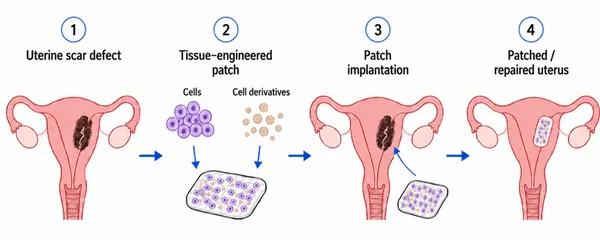
In the thesis, the researchers investigated whether biologically derived implants (biomaterials) can promote the healing and regeneration of uterine tissue. To produce these implants, the original cells were removed from donated tissue, while its natural supporting structure and growth factors were preserved.
“We have studied how such cell-free uterine tissue can be improved using stem cells, small particles released by cells known as extracellular vesicles, and various pretreatments.”
The studies involved experiments with rats and sheep, as well as laboratory studies in which the researchers examined tissue and cells outside the body.
Better but incomplete healing
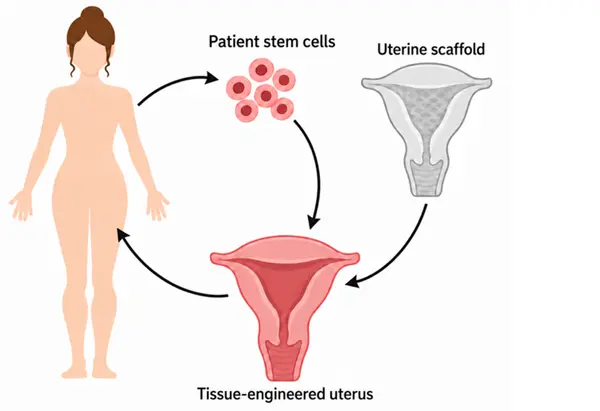
The findings show that cell-free uterine tissue can support the formation of new tissue. The researchers also found that certain methods could improve aspects of the healing process.
“Stem cells improved certain aspects of healing, and enzyme treatment made it easier for cells to grow into the tissue. However, we were unable to fully recreate the tissue.”
In the longer term, the research could contribute to new treatment options for women with uterine damage and infertility. So far, the findings come from experimental studies.
Challenging experiments
What have been the most rewarding and the most challenging parts of your doctoral project?
“The most rewarding part has been developing as a researcher, learning new methods, and working with knowledgeable and dedicated colleagues. It has also been exciting to see how the research has gradually progressed and led to new insights,” says Sara Bandstein and continues:
“The greatest challenges have been the technically demanding experiments and finding enough time for research, clinical work, and family life.”
Text: Jakob Lundberg

