The interaction of the beam with the specimen results in various types of signals, i.e. secondary and backscattered electrons as well as radiation and photons. During microscope training, our users learn how the different types of signals are generated and detected as well as which approach best suits their application.
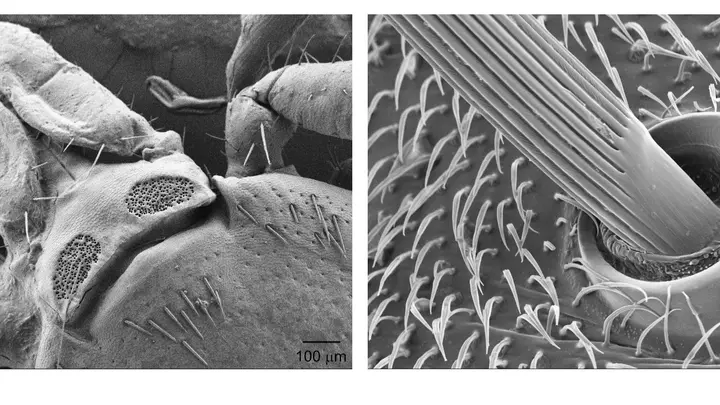
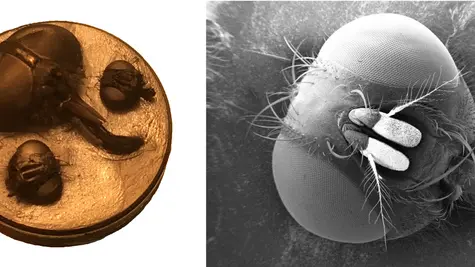
Topography Imaging
This type of imaging provides information about the surface details (shape, size etc.). Our Gemini II 450 is equipped with Everhart Thornley Secondary Electron Detector (ETD SE2) and InLens Secondary Electron Detector typically used for low to medium resolution and very high resolution details respectively. The amount of signal depends on topography with more signal typically being produced near edges.
Chemical Contrast Imaging
Atoms of various atomic numbers produce different amounts of backscattered electron signal. An image acquired using backscattered electrons will present brighter regions at locations where the sample is composed of higher atomic number atoms, and darker regions at locations where the sample is composed of lower atomic number atoms. Regions saturated with heavy metals (high atomic number), for example osmicated membranes, will therefore appear brighter than then carbon-based background of resin embedding medium (low atomic number).
Chemical contrast imaging is useful when topography itself is not enough to differentiate between various features of sample but one of the features has significantly different proportion of heavier atoms, or when there are only chemical differences present in the sample (see also Array tomography below). Angular Selective Backscatter Detector (BSD1) and InLens Energy selective Backscattered (EsB) Detector on our Gemini II 450 allow to image compositional contrast.
Left image: Synthetic polymer contaminant (*) on a metal surface visualized with the backscattered detector.
Right image: HeLa cell prepared for ultrastructure, embedded, sectioned and imaged with the backscattered detector.