Ways-of-life, stress and mental health in the primary care context
In this epidemiological and general medical and primary health care research project, we study possible risk and health factors in relation to stress at the population level, and how primary care can contribute to supporting the individual in preventing the effects of both mental and physical stress, as well as in treating and rehabilitating stress.
Overview
Project time
2018 - 2028
Budget (SEK)
FORTE 2018 SEK 7,796 million, FORTE 2019 SEK 1 million; ALF-grant 2022-2024 SEK 1,5 million, ALF-grant 2025-2027 SEK 1,5 million
Health Care Service and Management, Health Policy and Services and Health Economy
Public Health, Global Health and Social Medicine
Responsible organization
Institute of Medicine
Research financier
FORTE; the ALF-agreement
In this epidemiological and general medical and primary health care research project, we study possible risk and health factors in relation to stress at the population level, and how primary care can contribute to supporting the individual in preventing the effects of both mental and physical stress, as well as in treating and rehabilitating stress. We use longitudinal data from the Population Study of Women in Gothenburg, including the H70 study, which have followed populations for almost 50 years, and apply knowledge generated from these studies in intervention studies in primary care that aim to evaluate the effects of intervention against risk factors and promotion of health factors.
Background
There is a great need for increased knowledge about the long-term effects of stress, both in terms of physical and mental health and illness, and about possible preventive measures as well as treatment methods.
The vast majority of care in Sweden takes place in primary care, and in this overall epidemiological and general medical research project we study possible risk and health factors in relation to stress at the population level, and how primary care can help support the individual in preventing the effects of mental and physical (metabolic) stress, but also in the treatment and rehabilitation of stress.
We use longitudinal data from the Population Study of Women in Gothenburg, including the H70 study, which followed populations in terms of physical and mental health for almost 50 years, and apply knowledge generated from these studies in intervention studies in primary care aimed at evaluating the effects of intervention against risk factors and the promotion of health factors.
We study
intervention methods to reduce the experience of stress at the population and at primary care level
methods that promote the individual's own ability to manage stress, and
treatment of stress-related diseases in primary care
and evaluate whether the methods are effective and cost-effective and positive for the individual and leads to the possibility of improved health regardless of socio-economic background.
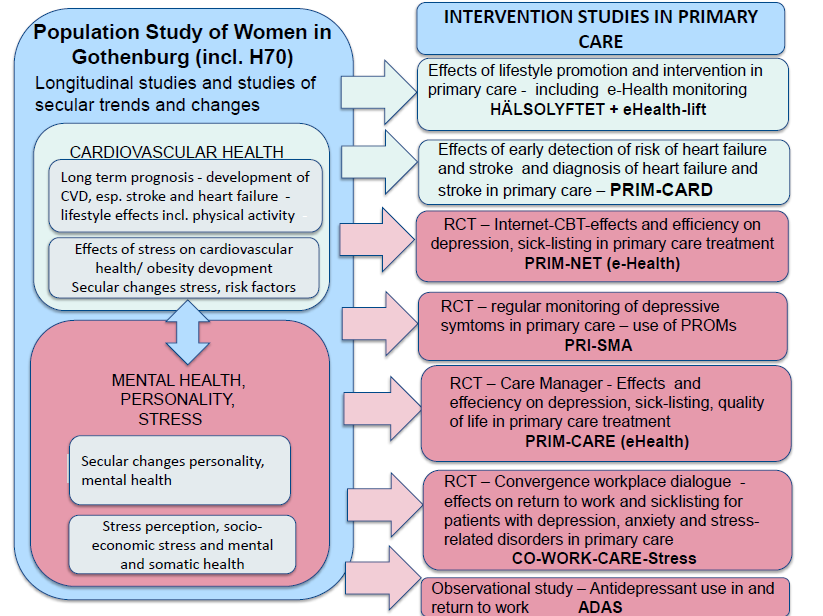
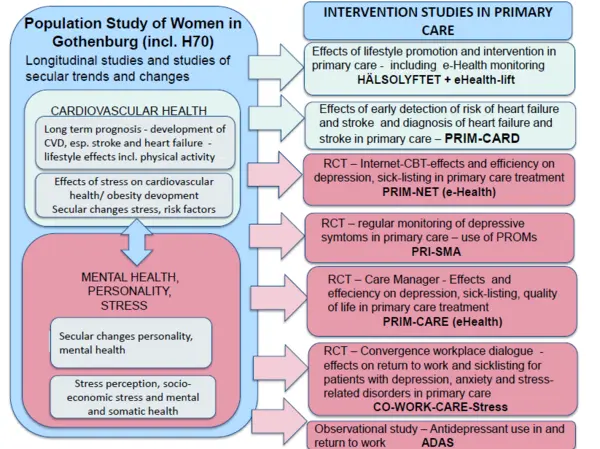
The figure below describes how epidemiological research results are transferred to implementation and intervention in primary care. The intervention studies that generate knowledge are Hälsolyftet, the Internet CBT study in primary care (PRIM-NET), the study of the use of self-assessment instruments for depression in primary care (PRI-SMA), the study of care coordinators and collaborative care for mental illness in primary care (PRIM-CARE) and study of collaboration around patients with depression, anxiety and stress reaction - Co-Work-Care.
PRIM-NET- Internet-CBT treatment of Depression in primary care
PRI-SMA – use of depression self-assessment instrument in primary care
PRIM-CARE – Care manager and collaborative care for common mental disorders in primary care
CO-WORK-CARE – convergence workplace dialogue and care management at the primary care centre for patients with depression, anxiety and stress-related disorders
Studies
A. Population based studies Longitudinal population based epidemiological studies, cohort comparisons and cross-sectional studies are used to gain knowledge about long term health effects as well as secular trends of mental and metabolic stress in women and men.
B1. Lifestyle interventions and promotion in primary care Hälsolyftet: Intervention of lifestyle in primary care
Overall purpose: To include multidimensional lifestyle intervention in studies on depression, anxiety, stress-related disorders and quality of life and work ability.
Purpose: To implement the program "Hälsolyftet" in primary care and via e-health in collaboration with Karolinska Institutet.
B 2. Studies of depression, anxiety and stress related mental disorder in primary care
Overall purpose: To investigate whether treatment of depression / common mental disorders in primary care can be improved in terms of symptoms of depression and anxiety, quality of life, ability to work, use of health care, sick leave and return to work.
Aim: The aim of four intervention projects is to study, in RCTs, whether treatment of depression / anxiety and stress-related mental illness in primary care can be improved by
i) Internet Cognitive Therapy (I-CBT) therapy (PRIM-NET; evaluation phase)
ii) Regular patient-centred methodology and evaluation of depressive symptoms and change using self-evaluation instruments, at GP visits and in primary care (PRI-SMA; evaluation phase)
iii) Care manager/collaborative care function at the health center (PRIM-CARE; evaluation phase)
iv) Person-centred convergence dialogue in the workplace (Co-Work-Care; planning phase) regarding outcome of care (depression, quality of life), sick leave, return to work and patient satisfaction, compared with treatment as usual / care as usual.
Grigoroglou C, van der Feltz-Cornelis C, Hodkinson A, Coventry PA, Zghebi SS, Kontopantelis E, Bower P, Lovell K, Gilbody S, Waheed W, Dickens C, Archer J, Blakemore A, Adler DA, Aragones E, Björkelund C, Bruce ML, Buszewicz M, Carney RM, Cole MG, Davidson KW, Gensichen J, Grote NK, Russo J, Huijbregts K, Huffman JC, Menchetti M, Patel V, Richards DA, Rollman B, Smit A, Zijlstra-Vlasveld MC, Wells KB, Zimmermann T, Unutzer J, Panagioti M. Effectiveness of collaborative care in reducing suicidal ideation: An individual participant data meta-analysis. Gen Hosp Psychiatry. 2021 Jul-Aug;71:27-35. doi: 10.1016/j.genhosppsych.2021.04.004. Epub 2021 Apr 21. PMID: 33915444.
Karyotaki E, Efthimiou O, Miguel C, Bermpohl FMG, Furukawa TA, Cuijpers P; Individual Patient Data Meta-Analyses for Depression (IPDMA-DE) Collaboration, Riper H, Patel V, Mira A, Gemmil AW, Yeung AS, Lange A, Williams AD, Mackinnon A, Geraedts A, van Straten A, Meyer B, Björkelund C, Knaevelsrud C, Beevers CG, Botella C, Strunk DR, Mohr DC, Ebert DD, Kessler D, Richards D, Littlewood E, Forsell E, Feng F, Wang F, Andersson G, Hadjistavropoulos H, Christensen H, Ezawa ID, Choi I, Rosso IM, Klein JP, Shumake J, Garcia-Campayo J, Milgrom J, Smith J, Montero-Marin J, Newby JM, Bretón-López J, Schneider J, Vernmark K, Bücker L, Sheeber LB, Warmerdam L, Farrer L, Heinrich M, Huibers MJH, Kivi M, Kraepelien M, Forand NR, Pugh N, Lindefors N, Lintvedt O, Zagorscak P, Carlbring P, Phillips R, Johansson R, Kessler RC, Brabyn S, Perini S, Rauch SL, Gilbody S, Moritz S, Berger T, Pop V, Kaldo V, Spek V, Forsell Y. Internet-Based Cognitive Behavioral Therapy for Depression: A Systematic Review and Individual Patient Data Network Meta-analysis. JAMA Psychiatry. 2021;78(4):361-371.