The study is being conducted at two care homes in Karlskoga Municipality and uses a mixed-methods approach, including walking interviews, assessments of indoor and outdoor environments and analysis of municipal planning documents. The project is expected to generate new knowledge about how different environments support or limit contact with nature and outdoor activities, and how these relate to health and wellbeing. By combining findings from the different methods, evidence-based recommendations will be developed for the planning and design of care homes. The final outcome will be updated strategic planning documents.
Project's full title: Design of care homes: From perceived environments to evidence-based recommendations supporting contact with nature and outdoor activities for the health and wellbeing of older people living with dementia and care home staff.
Background
The project was initiated in response to a specific need identified by Karlskoga Municipality. While planning a new care home, the municipality approached the research group for guidance on how indoor and outdoor environments should be designed to promote contact with nature and opportunities to spend time outdoors, supporting the health and wellbeing of older people living with dementia and care home staff.
The project therefore responds directly to the needs of a Swedish municipality seeking to incorporate health-promoting aspects into its strategic planning documents for care homes.
Aim
The aim of the research project is to investigate how the design of care homes, focusing on indoor and outdoor environments and opportunities for contact with nature and spending time outdoors, affects the health and wellbeing of older people living with dementia, as well as the working environment of care home staff.
Objectives
The objective is to develop evidence-based recommendations that ensure opportunities for contact with nature and spending time outdoors in care homes as a means of promoting health and wellbeing.
These recommendations will be incorporated into Karlskoga Municipality's strategic planning documents and will be applicable to the construction of new care homes, as well as the redevelopment or refurbishment of existing facilities.
More broadly, the project aims to establish an approach that can serve as a model and source of inspiration for Sweden's other 289 municipalities in their efforts to ensure high-quality care home environments.
Theoretical framework
The research project is based on the conceptual model Four Zones of Contact with the Outdoors. The model describes different zones of contact with outdoor environments, each with potential health benefits. It also takes into account people's body positions and cognitive abilities, while incorporating the perspectives of care home staff (Figure 1).
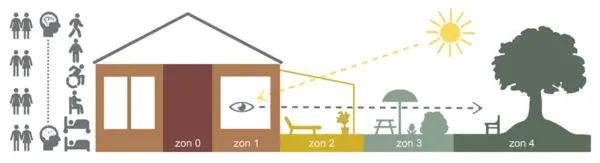
Applying the Four Zones model helps ensure that all four zones are accessible in care homes, creating favourable conditions for contact with nature, spending time outdoors and, in turn, promoting health and wellbeing.
Access to greenery is another essential factor in creating health-promoting outdoor environments. One useful tool is the 3-30-300 rule, where ‘3’ means that at least three trees should be visible from every window, ‘30’ refers to a minimum of 30 per cent tree canopy cover in the neighbourhood and ‘300’ means that the nearest park or green space should be no more than 300 metres away.
Method
The research project uses a mixed-methods approach, including walking interviews, assessments of indoor and outdoor environments and analysis of municipal planning documents. The study involves older people living with dementia and staff at two care homes in Karlskoga Municipality. Participants’ experiences and knowledge of how the physical environment affects health and wellbeing are central to the research.
Expected outcomes
The project is expected to provide new insights into how indoor and outdoor environments in care homes support or limit opportunities for contact with nature and spending time outdoors, and how this relates to the health and wellbeing of older people living with dementia and care home staff.
The study is also expected to produce practical recommendations for the planning and design of indoor and outdoor environments in care homes.
Organisation
The study is part of the . OUT-FIT, research project, which focuses on outdoor environments for health and wellbeing