
Supervisor: Anders Björkman
Co-supervisor: Joakim Strömberg och Martina Åhlén
Opponent: Thomas Hansson, Linköping University
Examining Committee: Hanna C. Persson, Erika Nyman, and Karin Svensson
Research area: Hand Surgery

Better finger mobility with passive exercises after surgery
Active mobilization is increasingly used after surgery for injured flexor tendons in the fingers. Sara Chevalley’s research shows that it did not produce better results than passive mobilization during the first year, and that the passive mobilization group had better finger mobility at long-term follow-up.
Injuries to the flexor tendons in the fingers are relatively common and often occur when handling sharp objects. A severed flexor tendon needs to be surgically repaired to restore its function.
“After surgery, rehabilitation exercises are needed to prevent scar tissue from restricting tendon movement. At the same time, the tendon must be protected from strain during the three-month healing period, as there is a risk of it rupturing again,” says Sara Chevalley, senior consultant at the Department of Hand Surgery at Sahlgrenska University Hospital and doctoral student at the Institute of Clinical Sciences.
Two rehabilitation methods compared
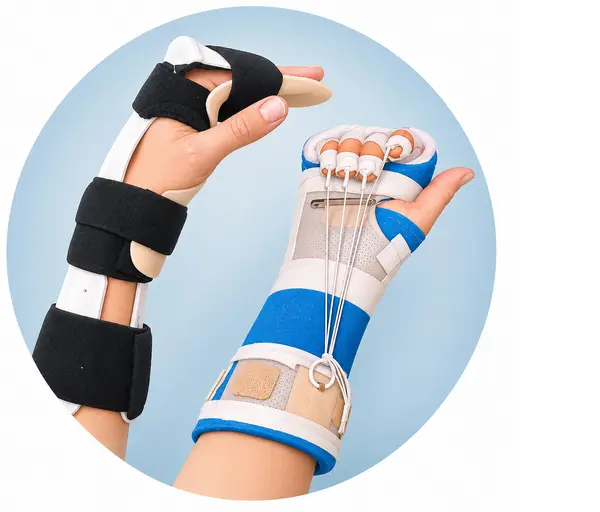
In passive mobilization, the fingers are bent using elastic bands and the other hand. This can be combined with a technique known as place-and-hold, in which patients hold their fingers in a bent position. In active mobilization, patients gently bend their fingers using their own muscle strength.
“My research has examined which of these rehabilitation methods produces the best outcomes for patients.”
Patients were randomly assigned to one of the two methods and followed for one year. The same groups were examined again at least five years after surgery.
Better mobility in the long term
During the first year, the researchers found no differences between the groups in finger mobility or grip strength.
“At long-term follow-up, however, finger mobility was better in the passive mobilization group. In the active group, mobility had declined since the one-year follow-up, and patients had more difficulty straightening the injured fingers.”
In patient questionnaires, stiffness and weakness were the most common complaints during the first year. Interviews after rehabilitation had ended also showed that many patients were frustrated by being unable to use their hands as usual. Patients’ experiences did not differ clearly between the two groups.
Challenging an established belief
What have been the most enjoyable and the most challenging parts of your doctoral project?
“It has been both enjoyable and rewarding to deepen my knowledge in this field, as I often treat patients with flexor tendon injuries in my clinical work,” says Sara Chevalley and continues:
“One challenge has been the widespread belief that active mobilization is better. It is now used by most practitioners, even though there is still no scientific evidence that it produces better outcomes than passive mobilization with place-and-hold.”
Text: Jakob Lundberg
