Area: Marine Biology
Level: Master project
Contact: Johan Svenson, Cawthron Institute, Pierre de Wit, University of Gothenburg
Location: Cawthron Institute, Nelson, New Zealand
Background
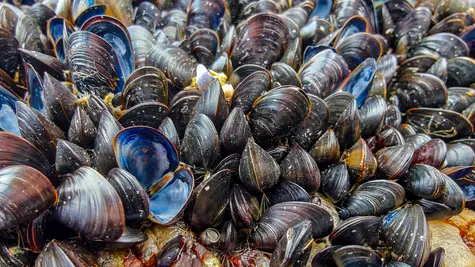
Bivalves, including green-lipped mussels/kūtai (Perna canaliculus), naturally show different growth phenotypes (slow and fast growers).
Our observations in the laboratory have shown that larger juvenile mussels are more sensitive to thermal stress than their smaller siblings suggesting individual-level trade-offs between growth and thermal tolerance.
Project overview
This project will use multiple approaches to investigate the physiological responses (e.g., respiration rate and clearance rate) of fast- and slow-growing full-sibling mussels.
The study will disentangle the effects of age and size on thermotolerance by testing juvenile mussels of the same age that have reached different sizes, as well as mussels that have reached a similar size at different ages. These mussels will also be exposed to an environmental stressor (a simulated marine heatwave), allowing us to assess how physiological responses in divergent phenotypes may influence the resilience of natural mussel populations under climate change.
All practical work will be carried out at the Cawthron Aquaculture park based near Nelson, South Island, New Zealand. The park has comprehensive marine animal husbandry and laboratory facilities, as well as staff/student offices accommodating approximately 40 researchers and technicians. A physiology lab will be made available to this project, which will allow juvenile marine mussels to be maintained under optimum conditions, the potential to administer experimental treatments, apply assessment challenges and test physiological response. Training will be provided in appropriate data exploration and analysis methods, including modelling to interpret biological outcome data.
Two commercial mussel hatcheries operate at the Aquaculture Park; these will provide regular access to high-quality juvenile mussels throughout the project period.
Contacts
Natali Delorme: Natali.Delorme@cawthron.org.nz
Jess Ericson: Jess.ericson@cawthron.org.nz
Johan Svenson: Johan.Svenson@cawthron.org.nz
More about Cawthron
Cawthron Institute is New Zealand’s largest and oldest independent research organisation with a 100-year history of delivering practical research solutions that benefit New Zealand and the rest of the world.
The majority of the research undertaken at Cawthron is focused on the marine and freshwater environment. Cawthron’s purpose is to deliver world class science for a better future. We partner with Māori, industry, academia, international stakeholders and government to deliver on our outcomes of healthy ecosystems, a prospering blue economy, thriving people and communities and our five impact pathways:
- Turning the tide on climate change
- Protecting and enhancing aquatic environments
- Securing safe and sustainable food
- Realising the potential of algae
- Supporting resilient communities in the Pacific
Project resources
During the New Zealand-based phase of the project, Cawthron will provide full host support, including:
- Access to necessary practical research facilities and materials
- Supervision, training, mentoring and technical support, as required
- Personal desk space and access to internal network and internet
- Incorporation into Cawthron staff, student and early career researcher networking groups
Support costs (including Cawthron staff time) will be covered by Cawthron.