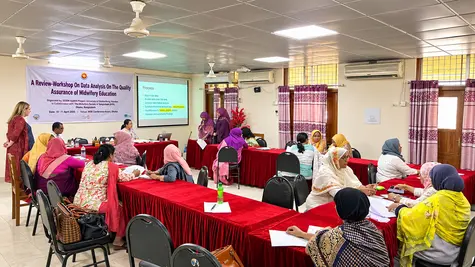
However, a new curriculum does not automatically lead to better education. Educators need the knowledge, skills and support to put it into practice. The project therefore aims to identify the competencies midwifery educators need to deliver the new programme and, based on the findings, develop approaches to support their continuing professional development. The goal is to establish sustainable conditions for high-quality, competency-based midwifery education in Rwanda.
Background
Rwanda has developed nationally standardised, competency-based curricula for midwifery education, aligned with national needs and international competency standards. For the educational reform to achieve its intended outcomes, midwifery educators must have the competencies required to translate the curricula into teaching and assessment. However, knowledge remains limited about educators' existing competencies and professional development needs in relation to delivering competency-based midwifery education.
Methods
The project is conducted in several interconnected phases. Initially, nationally standardised, competency-based curricula for midwifery education are developed and implemented through a participatory process involving national stakeholders from education, the midwifery profession and healthcare.
This is followed by a national cross-sectional study involving midwifery educators at all higher education institutions offering midwifery programmes in Rwanda. The study examines educators' competencies and professional development needs in areas relevant to implementing competency-based education, including teaching and assessment, clinical learning and simulation, research, leadership and quality improvement.
The findings inform the next phase, in which a contextually adapted model for the continuing professional development of midwifery educators is developed. The model is developed and validated through a structured co-creation and consensus process involving national stakeholders. It draws on empirical findings, the competency-based curricula and international standards for the professional development of midwifery educators.
Significance and expected outcomes
The project is expected to generate knowledge about the competencies and support midwifery educators need to deliver competency-based education, and to translate this knowledge into a nationally endorsed model for continuing professional development.
By combining curriculum development, an empirical assessment of educators' needs and targeted professional development, the project aims to establish the conditions for sustainable implementation of competency-based midwifery education.
In the longer term, the goal is to improve the quality of midwifery education and thereby contribute to preparing midwives with the competencies needed to provide safe, evidence-based care for women, newborns and their families.
Organisation
Research group: Sexual, Reproductive and Perinatal Health