


JOHNNA SAHLSTEN SCHÖLIN
Dissertation defense: 6 December 2024 (click for details)
Doctoral thesis: Clinical outcome and ethical perspectives in internationally adopted children with cleft lip and palate
Research area: Plastic Surgery
Sahlgrenska Academy, The Institute of Clinical Sciences
Johnna Sahlsten Schölin is a senior physician at the Department of Plastic Surgery, Sahlgrenska University Hospital, and a doctoral student at the Institute of Clinical Sciences. In her thesis, she has examined differences in surgical outcomes, speech, hearing, and facial growth between children adopted from other countries and Swedish-born children with cleft lip and palate.
More surgeries and speech problems
What are the main findings of your research?
“The adopted children arrived at older ages than before, underwent palate surgery later than the Swedish-born children, and required more surgeries to achieve a complete and functional palate. By age five, they were also more likely to experience speech problems. Mild hearing loss was somewhat more common among the adopted children. Facial growth was also more commonly affected, meaning that more of them will likely need jaw surgery in the future,” says Johnna Sahlsten Schölin.
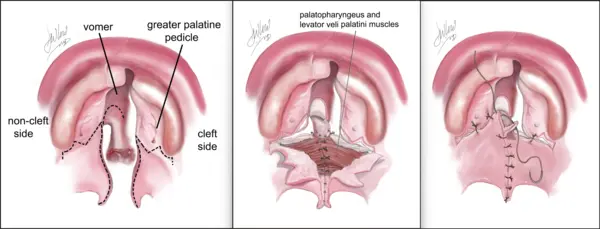
Figure from the thesis. Two-stage soft palate repair, a method for palate surgery used in Gothenburg since the 1990s. From "Interdisciplinary Cleft Care": Global Perspectives (pp. 742) by Usama S. Hamdan, Carolyn R. Rogers-Vizena, Brian C. Sommerlad, Raj M. Vyas, and David W. Low. From chapter 26: Staged palate repair; Soft palate first, Hans Mark and Jan Lilja. Copyright © 2023 Plural Publishing, Inc. All rights reserved. Used with permission.
Ethical analysis and need for guidelines
The research also includes an ethical analysis of the care provided to these children. Johnna Sahlsten Schölin believes there is a need for guidelines at both national and international levels to improve care for adopted children with CLP.
“Our analyses highlighted several important areas, including the need to clarify the complexity of healthcare requirements for these children. Guidelines could provide better support for parents before and after adoption.”

Figure from the thesis. (A) Cleft lip, (B) Cleft palate, (C) Unilateral cleft lip and palate, (D) Bilateral cleft lip and palate. Illustration: Liisi Raud-Westberg, Niclas Löfgren.
Multifaceted and compassionate work
What has been the most rewarding aspect of the project, and what has been challenging?
“It has been incredibly rewarding to conduct research in a field that is both exciting, multifaceted, and compassionate. One challenge was that many adopted children arrived here with untreated clefts at older ages than in previous years, and sometimes with additional health issues. Capturing the questions arising from our multidisciplinary treatment approach and starting the work was both satisfying and difficult,” says Johnna Sahlsten Schölin, adding:
“The complexity of caring for children with CLP has posed challenges in the research, as surgery, speech, hearing, and dental development are interconnected and affect one another. Research on CLP involves growing individuals, and it is always challenging to determine the precise impact of time on the factors we measure.”
Text: Jakob Lundberg
