
Ancient votive offerings shed light on women’s religious roles
Objects offered to the goddess Hera more than 2,500 years ago can provide new perspectives on women’s roles in ancient religious life. A new doctoral thesis from the University of Gothenburg also shows how researchers and museums shape our understanding of these objects.
In her thesis, Jenny Högström Berntson examines votive gifts– objects that people gave to gods – from the Heraion at the mouth of the River Sele in southern Italy. The sanctuary was dedicated to the goddess Hera and was located near the ancient Greek colony of Poseidonia, present-day Paestum.
The study focuses on two types of votive offerings: terracotta figurines depicting groups of dancing women, and keys offered at the sanctuary.
– The objects can be linked to various significant gender-related roles in ancient society. They allow us to investigate women’s roles in religious contexts, but also how these roles have subsequently been made visible or rendered invisible by researchers and museums, says Jenny Högström Berntson.
Tracing the ‘lives’ of objects
The thesis combines iconological analysis with theories concerning the function and ‘life histories’ of objects. Jenny Högström Berntson examines not only what function the votive gifts had in antiquity, but also how they have subsequently been interpreted by researchers and how they are presented to visitors at the museum in Paestum today.
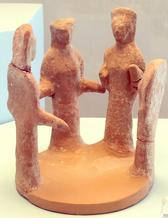
– The narratives that researchers and museums choose to highlight affect how we perceive the objects and, consequently, how we understand the past. The objects were not merely bearers of meaning in antiquity; they continue to play an active role as cultural heritage is created and reinterpreted in our own time, says Jenny Högström Berntson.
A threefold function
Among other things, the study shows that the religious meanings of the votive gifts in antiquity are given limited space in the museum’s presentation. As a result, knowledge about ancient religion and women’s roles in society risks being absent from the narrative conveyed to today’s museum visitors.
A new theoretical concept introduced in the thesis is the idea of the votive offering’s ‘threefold function’. It highlights how the votives could acquire meaning on several levels through the interplay between people, gods and society. Meaning was created not only through the act of presenting the object to a deity, but was also reinforced when it was placed and displayed in the sanctuary.
– By tracing the different life histories of votives, we can access more aspects of these objects. We can gain new knowledge about their significance in antiquity, while also becoming more aware of what happens to the objects when they become part of our modern cultural heritage, says Jenny Högström Berntson.
The thesis Mellan kult och kulturarv. Votivgåvor som betydelsebärande föremål – dansgrupper och nycklar från Heraion vid Sele (Between cult and cultural heritage: Votive offerings as objects bearing meaning – dance groups and keys from the Heraion at Sele) will be publicly defended on 4 September at 13:15 in Jubileumssalen (J222), Humanisten, Renströmsgatan 6, Gothenburg.
The thesis is available digitally: https://hdl.handle.net/2077/91389
Contact:
Jenny Högström Berntson, tel.: 0766-18 44 09, email: jenny.hogstrom@gu.se