Each year, the School of Business, Economics and Law hosts the Tore Browaldh Lecture. A prominent, invited lecturer highlights topics like the relationship between economics, economic theory or economic systems on the one hand and social attitudes, political systems and philosophy on the other.
In 1988, the Board of Directors at AB Volvo made a decision, by way of acknowledgement of Tore Browaldh's many years of service as a board member, to allocate funds to a foundation to be administered by the School of Business, Economics an Law at the University of Gothenburg. The purpose of this foundation should be to arrange a public lecture once a year, known as the Tore Browaldh lecture at the School of Business and Economics at Göteborg University. The first lecture took place in 1989.
Powerful technology companies increasingly shape how information spreads, how markets function, and how political power is contested. As mobile broadband technologies expand their reach, they are transforming industries, altering incentives for political actors, and reshaping the balance of power between citizens, governments, and corporations. At the same time, the digital information ecosystem raises urgent questions about disinformation, accountability, and the resilience of democratic institutions.
After the lecture Cecilia Malmström will lead a Q&A session with the audience.
About the speaker
Sergei Guriev is the tenth Dean of London Business School, a position he has held since August 2024. Prior to his appointment, Sergei Guriev served as Professor of Economics and Rector at the New Economic School in Moscow, Professor of Economics and Provost at Sciences Po, Paris, and Chief Economist at the European Bank for Reconstruction and Development.
Dean Guriev is a Research Fellow at the Centre for Economic Policy Research, London and a Global Member of the Trilateral Commission. In 2006, he was selected a Young Global Leader by the World Economic Forum. He is also a member of the Group of Thirty.
How did we move from a world in which discrimination against women was not recognized as an issue, in which women were routinely and legally fired when they were married or when they became pregnant, and in which they could not always get a credit card in their name or pick their own name legally, to the world we now live in, however imperfect? And what impact do expanded rights have on women, their families, and the economy generally?
Claudia Goldin is the Henry Lee Professor of Economics at Harvard University and holds the Lee and Ezpeleta Professorship of Arts & Sciences at Harvard University. She is an economic historian and labor economist whose research spans topics such as the female labor force, the gender gap in earnings, income inequality, technological change, education, and immigration. Most of her research interprets the present through the lens of the past and explores the origins of current issues of concern.
Professor Goldin is the recipient of the 2023 Sveriges Riksbank Prize in Economic Sciences in Memory of Alfred Nobel for advancing our understanding of women's labor market outcomes.
We are entering a new era for the world economy, as the pandemic, geopolitics, climate change, and the demands of domestic social and political agendas have overwhelmed the hyper-globalization “consensus” that prevailed until recently. In this year's Tore Browaldh Lecture, Dani Rodrik, Professor at Harvard University, will sketch out possible futures for globalization.
Dani Rodrik is Ford Foundation Professor of International Political Economy at the Harvard Kennedy School.
Transitions seem to turn us away from rather than towards liberty. Timothy Snyder, well known Professor and author of "On Tyranny“ will speak at the Tore Browaldh Lecture on what we did get wrong and what we have learned.
Rethinking Value Creation - for innovation-led inclusive & sustainable growth.
Where does wealth come from, who creates it and what destroys it? This webinar will deep dive into global economics, as professor Mariana Mazzucato explains how capitalism can be steered toward a bold, innovative and sustainable future that works for all of us.
Why is the economics of climate change so difficult and controversial?
His talk will provide a fast-paced crash course on why the economics of climate change is so especially difficult and so especially controversial.
50 years of the Altman Z-Score model and its applications to financial and managerial markets
Professor Altman will discuss the applications of credit scoring models, including his own Z-Score family of models for financial and managerial markets. He will relate what these models are saying about the current conditions and outlook for global credit markets.
Can we trust scientific results?
There is increasing concern about the fact that many scientific results have been impossible to reproduce. This is problematic since reproducibility is a central cornerstone of scientific research. Indeed, if a finding cannot be reproduced, there are good reasons to question the finding itself. Factors contributing to a lack of reproducibility include low statistical power, publication bias, and testing of hypotheses with low prior probability of being true.
Climate Change, Risk, and Population Ethics
The actions of the current generation could have profound and far-reaching effects on future generations as is well illustrated by different climate change scenarios. This fact raises new and important but very difficult moral questions.
Europe and migrants – progress and setbacks
Cecilia Malmström, EU Commissioner for Home Affairs, and soon European Commissioner for Trade. Since 2010 she has been responsible for the European Commission’s work within the fields of asylum and migration, police cooperation, border control, and the fight against organized crime and human trafficking. Cecilia Malmström is formerly a Member of the European Parliament and Minister for European Affairs of Sweden. She has a Ph.D. in political science and was a researcher at the University of Gothenburg for several years, teaching in European politics.
Crises in the Euro-zone and in banks - 'too big to fail' and 'too big to save'
The lecture will focus on the need for reforms to reduce the fragility of the financial sector, as well as to enhance growth and adjustment within each country. Are EU and national decision-making bodies up to the task?
Reforming strategic analysis to meet the challenges of global competition
What have we learned from the crisis?
Paul Krugman an American economist, columnist, blogger, author and intellectual. In 2008 he was awarded The Sveriges Riksbank Prize in Economic Sciences in Memory of Alfred Nobel for his work associated with New Trade Theory and for his analysis of trade patterns and location of economic activity.
Strategies for a Swedish Business School in Global Competition
This lecture attempts to set out some prepositions for achieving effective strategies for Business Schools in global competition. A fundamental premise is strong focus on research, but relevant to business. This must then be brought into the classroom fast. The interchange here - between new thinking and strong insights from class participants - is key.
The intellectual origins of modern economic growth
Growth issues, global competitiveness and welfare development are often on the agenda in the public debate. But it is very rare that the discussion is conducted with knowledge of the factors that create growth. The economic-historical theories often shine with their absence.
To add new dimensions to the debate, we have invited Professor Joel Mokyr to talk about the intellectual origins of modern growth thinking.
2003 - Professor Nicholas F. R. Crafts: Globalization in History: a Geographical Perspective 2001 - Professor Nathan Rosenberg: University-Industry Relations and their Influence on the Competitiveness of Nations Direktör Björn Stigson: Globalisering och företagens ansvar för miljö och social utveckling - World Business Council´s syn och roll 1999 - Jubilee lecture: Moral och omoral i det ekonomiska livet
- Professor Hans De Geer: Moralen i skandalen eller den vita vågen
- Direktör Leif Vindevåg: Etiska affärer - kan det löna sig?
- Panel discussion: Kan man lagstifta om etik i affärslivet? 1997 - Professor Saskia Sassen, Columbia University Dr Sirkka Hämäläinen: The European Monetary Union ¿ Principles and Perspectives Professor Assar Lindbeck: Den europeiska välfärdsstaten Professor John H. Dunning: Some Paradoxes of the Emerging Global Economy: The Multinational Solution Professor Christian Grönroos: Service och kundrelationer i företagens marknadsföring Professor Paolo Cecchini: From the European Community to the European Union - The Enhanced Commitment of the Member States Professor Peter Hall: The European City System Professor Horst Albach: The Unification between East and West Germany - Problems of Economic Restructuring and Research. Approaches to Solve them. 1989 Sir Ralf Dahrendorf: Transitions. Politics, Economics and Liberty
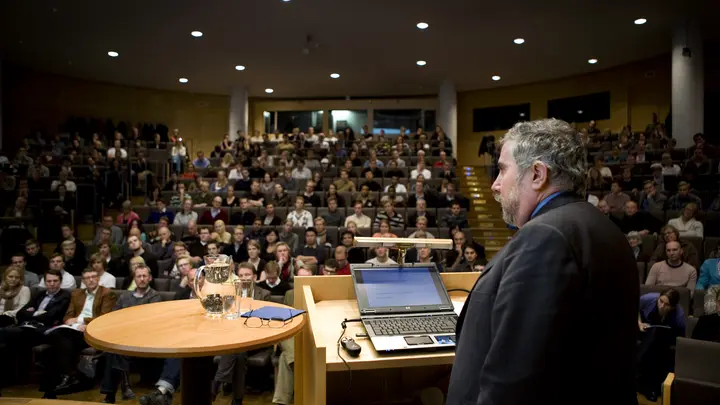
Paul Krugman at the 2009 Tore Browaldh Lecture
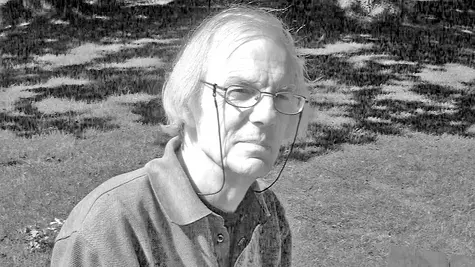
Who was Tore Browaldh?
Dr Tore Browaldh was born in Stockholm in 1917. He worked as a finance attaché at the Swedish embassy in Washington in 1943 and as a secretary for the post-war commission at the Ministry of Finance from 1944 to 1945, while at the same time being affiliated to the Research Institute of Industrial Economics. He worked as a secretary for the Handelsbanken Board of Directors from 1946 to 1949, as a director at the Council of Europe in Strasbourg from 1949 to 1951, and as a deputy managing director for the Swedish Employers Confederation from 1951 to 1954. From 1955, he worked as the managing director at Svenska Handelsbanken until 1966, as chairman of the board from 1966 to 1978, as first vice chairman from 1978 to 1988, and as an honorary chairman from 1988 until his death in 2007.
Tore Browaldh received an honorary doctorate from the Royal Institute of Technology, Stockholm in 1967 and an honorary doctorate from Göteborg University in 1980. For many years, he was chairman of the board at AB Volvo, AB Industrivärden, Svenska Cellulosa AB, Svenska IBM AB, Svenska Unilever AB and Sandrews, and vice chairman of the Nobel Foundation. He was a member of the Unilever Advisory Board, IBM World Trade Corp. and the International Advisory Board of AB Volvo. He also wrote a number of books, including the autobiographies Gesällvandring (1976), Vägen vidare (1980) and Motlut och medvind (1984).
The Board of Directors at AB Volvo made a decision in 1988, by way of acknowledgement of Tore Browaldh's many years of service as a board member, to allocate funds to a foundation to be administered by the School of Business and Economics at Göteborg University. The purpose of this foundation shall be to arrange a public lecture once a year, known as the "Tore Browaldh lecture at the School of Business and Economics at Göteborg University", within the field of economics or social sciences, with priority for subjects which illustrate the relationship between economics, economic theory or economic systems on the one hand and social attitudes, political systems and philosophy on the other. The first lecture took place in 1989.