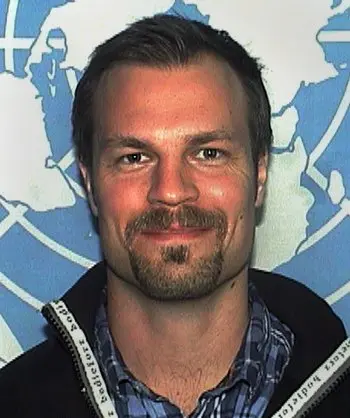
The Joakim Dungel Lectures in International Justice were founded in memory of Joakim Dungel, an alumnus of Gothenburg University, with the aim to deepen our understanding of justice-related issues world by analysing them through an international law lens.
Joakim Dungel, an alumnus of Gothenburg University (Jur kand. '04) and New York University (LL.M. '07), was killed on 1 April 2011 in Mazar-i-Sharif, Afghanistan, where he was working as a human rights legal officer for the United Nations.
In Joakim's brief existence, he blazed the trails of international justice, working for the United Nations International Criminal Tribunals for the former Yugoslavia and Rwanda, the Special Court for Sierra Leone, the Temporary International Presence in Hebron, and the United Nations Assistance Mission in Afghanistan.
Joakim was also a prolific author and published scholarly works on a wide range of issues, including command responsibility, the protection of national security interests, the right to humanitarian assistance during internal armed conflicts, and crimes against humanity.
For the purpose of honouring Joakim's life and work, Joakim's family and friends have, together with Gothenburg University, instituted the annual Joakim Dungel Lectures in International Justice, at which leading scholars and practitioners in the field of international human rights, international humanitarian law, and international criminal law will present lectures that seek to advance the bounds of our knowledge in order to bring justice to those in dire need.
Book chapter written by Emilia Dungel and Sari Kouvo
Past Lectures
The role of international law, especially international humanitarian law and international criminal law, in protecting civilians in conflict and promoting accountability after conflict has been a recurrent topic of the Joakim Dungel Lectures of International Justice. Over the past 15 years, we have explored changes in international humanitarian law, progress on prosecuting sexual and gender-based war crimes, environmental war crimes, and the role of international criminal law.
With the help of speakers who have contributed to past lectures, this year’s panel discussion takes stock of past decades’ developments of international law and investigates future spaces for justice in a changing global landscape.
Joachim Åhman, Professor of International Law, Department of Law, School of Business, Economics and Law
Emilia Dungel, Chair, The Association in Memory of Joakim Dungel
Niki Ganz, Deputy Director, Office of the Assistant Secretary-General for Middle East, Europe, the Americas, Asia and the Pacific, United Nations
Wendy MacClinchy, Director of the United Nations Program, Centre for Civilians in Conflict
Sari Kouvo, Associate Professor, Department of Law International Law, School of Business, Economics and Law
The responsibility of states to protect the climate system is an ongoing and continuously evolving topic. When international and national politics fall short of solutions for the climate crisis, states and non-state actors are turning to international law and its courts. The emerging cases and advisory opinions are shaping international law and jurisprudence.
A coalition of 132 nations, led by the Republic of Vanuatu, has requested the International Court of Justice (ICJ) to provide an advisory opinion on states’ obligations to protect the climate system and their responsibility in harming it. Similarly, the International Tribunal of the Law of the Sea (ITLOS), upon request from the Commission of Small Island States on Climate Change and International Law (COSIS), has unequivocally confirmed that states have an obligation to prevent and reduce greenhouse gas emissions to mitigate the impacts of climate change on the marine environment. Further, the Government of Ukraine-established High-Level Working Group on the Environmental Consequences of the War has published an Environmental Compact for Ukraine. This Compact identified accountability as one of its three priorities – reigniting discussions about the recognition of ecocide, the wilful and severe damage to the environment, as an international crime.
The 2024 edition of the Joakim Dungel Lectures in International Justice will take a deep dive into the role of private military and security companies (PMSCs) in contemporary conflict zones. The presence of private actors on battlefields or as protectors of key assets in conflict situations is not a new phenomenon but one that has risen to notoriety with the conflicts in Afghanistan, Iraq, Central African Republic, Mali and, most recently, Ukraine.
From a state actor perspective, PMSCs can be a way to complement insufficient or inefficient security forces, but equally provide a means to shroud interests and engagement in a particular conflict–including responsibilities for possible violations committed during such engagement. For private actors, providing security or actively participating in conflicts may provide lucrative business opportunities.
Through concrete examples from the field, this Joakim Dungel lecture will seek to unpack the implications on the international legal system of the increasing prevalence of PMSC actors. The lecture will also dig into important questions about how PMSCs should be regulated and how they can be held accountable for possible violations of human rights and humanitarian law. More specifically, the lecture will seek to answer the following questions:
What does it mean for the idea of the state when wars are fought by private actors?
How do the laws of war or international human rights law apply to PMSCs, and what mechanisms are there to hold them accountable for their violations?
What other means are there to regulate PMSCs, including how they are resourced and paid?
How can we understand the relation between states’ reliance on PMSCs and UN peacekeeping?
The nuclear threat is growing. Escalating warfare, political posturing, and geopolitical shifts raise the immediacy of concerns regarding the immense destruction that the use of nuclear weapons would leave in their wake.
The 2023 edition of the Joakim Dungel Lectures in International Justice will seek to make sense of the issue as our speakers help us understand the technology, history, legality, and politics of nuclear weapons. The speakers will also draw on their extensive experience and research to shed light on efforts to regulate nuclear weapons, and what this regulation and the multilateralism it depends on mean in an increasingly conflict-prone and polarized global setting.
In response to the September 11 attacks, the United States and its allies entered Afghanistan in 2001 to remove the Taliban from power. The US-led “War on Terror” intervention prompted the United Nations and other international allies to engage in a broad range of state-building and development activities in Afghanistan. There were a number of important initial successes, including the adoption of a new Constitution, elections, and roll-out of primary school programs. Quickly though, cracks were showing in the new democratic institutions, the Afghan security apparatus, and the reach of development programs.
Twenty years later, in the summer of 2021, the US withdrew its troops from Afghanistan. Within weeks, the Taliban had seized power and the Afghan government—backed since its establishment by the international community—had fallen. Criticism against the military operations led by the US and NATO and the state-building exercises sponsored by the UN and the international community has been harsh, but merited. The collapse of the Afghan government represents a failure of international interventions military as well as civilian.
However, a closer look at developments in Afghanistan over the past two decades shows a more complex picture of conflicting international, national, and local agendas, and similarly reveals a morphing conflict that has provided opportunities for a broad spectrum of actors of differing convictions and interests. How can we understand the oft-criticized Western-led interventions in this context, and what will it mean for the future of such efforts?
The 2022 edition of the Joakim Dungel Lectures in International Justice takes its starting point in the developments over the past two decades in Afghanistan, looking at how the intervention unfolded and why it failed. We ask:
How is the War on Terror changing international law and interventions?
Drawing on lessons from the past decades of state-building and military interventions, what are the main challenges for international law and justice?
Session I
Polarization and International Law: Government and Legal Perspectives
Polarization from a Global Perspective: Viewpoints from Diplomacy Ann Wilkens, Ambassador
Polarization and International Law: Viewpoints from Academia Sari Kouvo, Associate Professor, Department of Law, Gothenburg Univeristy
Session II
Working with Human Rights in Polarized Times: Regional and National Perspectives
Polarization, Human Rights and International Law: Lessons from the Middle East Habib Nassar, Director of Policy and Research, Impunity Watch
Freedom of Media and Expression in Contemporary Europe: Possibilities and Challenges Andrew Stroehlein, European Media Director, Human Rights Watch
Session 3
Future Challenges for Human Rights and International Law in a Polarized World: Concluding Discussion
Polarization and Human Rights in a Digitalized World: What Can We Expect? Professor Susan Perry, American University, Paris
Session I
International Perspectives on the Arms Trade Treaty: Law, Politics and Conflict Sari Kouvo
The Global Authorized Arms Trade: Facts, Figures, and Context Paul Holtom
The Arms Trade Treaty: Background, Aims, and Context, Paul Beijer and Paul Holtom
Session II Swedish Perspectives on the Arms Trade Treaty and Sweden: Law, Politics, and Business Paul Holtom
The Swedish Defense Industry and Arms Trade: Facts, Figures and Developments Linda Åkerström
Sweden’s Role in Implementing the Arms Trade Treaty Paul Beijer
The international legal framework to address climate change Marianna Bolshakova, Legal Officer, Legal Affairs Programme, United Nations Framework Convention on Climate Change
Land: Land and the Protection of Human Rights, the Guarantee of Justice, and the Realization of World Peace Richard Byron-Cox, Action Programme Alignment and Capacity Building Officer, The United Nations Convention to Combat Desertification (UNCCD)
Sea: Environmental Justice in the Oceans—A Conceptual Analysis of Legal Frameworks Applicable to the Remediation of Sea-Dumped Chemical Weapons Grant Dawson, Principal Legal Officer, Organisation for the Prohibition of Chemical Weapons (OPCW)
Biological and Chemical Weapons Dr. Robert Heinsch, Associate Professor, University of Leiden
Dr. Valeria Santori, International Consultant, Former Senior Policy Officer with the Organisation for the Prohibition of Chemical Weapons
Session II
Nuclear Weapons Dr. Tytti Erästö, Stockholm International Peace Research Institute (SIPRI)
Panel discussion and Q&A session Josefin Lind, Swedish Physicians Against Nuclear Weapons
Dr. Mikael Baaz, Associate Professor, University of Gothenburg
Dr. Robert Heinsch, Dr. Valeria Santori, Dr. Tytti Erästö
Moderator: Dr. Andreas Moberg, Associate Professor, University of Gothenburg
International Core Crime vs transnational crime – where does the crime of terrorism stand? Philipp Ambach, Chief of the Victims Participation and Reparation Section in the Registry of the International Criminal Court (ICC)
Combatting terrorism “bottom-up”- globalisation of States’ responses to an emerging global threat Nicolas Guillou, Chef de Cabinet to the President of the Special Tribunal for Lebanon
Combatting terrorism “top down” – the UNSC’s initiatives to tackle a new global problem Kimberly Prost, Chef de Cabinet to the President of the International Criminal Court
Global Context
Presentation on the evolution of the foreign terrorist fighter phenomenon and the response of the international community. Nikolaus Schultz, UN Counter-Terrorism Committee Executive Directorate, New York
Local Context
A perspective from those working with the topic in the Swedish society will give the audience contextual knowledge a in order to further understand both the problem and the proposed legislative measures to combat it. Are the trends and underlying reasons the same as in the global context? Evin Ismail, Uppsala University and Zan Jankowski, City of Gothenburg
Swedish law
Currently voices are calling for the Swedish legislator to act. The Swedish government has ordered a number of inquiries, some of which have received quite heavy criticism when presented. What proposals for legislation are currently on the table? Is there Swedish Law in force prohibiting the active participation as an FF/FTF? Gustaf Almkvist, Uppsala University
Comparative law
There is an on-going debate about how to counter the ongoing recruitment of men and women into terror groups operating mainly in the Middle East. Swedish Media tends to focus on the shortcomings of the authorities in this endeavour. What is the current state of legislation to combat terrorism and in particular to prevent the travel of foreign fighters in other jurisdictions? Manuel Eising, Senior Legal Adviser, OSCE Secretariat - Action against Terrorism Unit
International law
In order to tie everything together, a session on International Law connects the topic to available international legislation. What rules of contemporary international law are applicable? What future change is envisaged? What is the difference, if any, between a mercenary, PMC, FF, FTF? Svetlana Martynova, UN Counter-Terrorism Committee Executive Directorate, New York (Via Videolink)
Criminalisation of participation through terrorist organisations in armed conflict
Is there a need to criminalise participation in armed conflict on the side of a terrorist organisation? This question is currently on the table, as a Swedish government inquiry works with this delicate issue in the interface between national law and International Humanitarian Law. Ola Engdahl, Swedish Defence University, Expert counselor to the Inquiry to prevent and combat terrorism
Mikael Bernardini, Gothenburg University
Christer Mattson, Segerstedtinstitutet, Gothenburg University
Preventing Sexual Violence in Conflicts: Lessons from the EU crisis management and the Afghan conflict Sari Kouvo, EEAS, Department of Law, Gothenburg University
Preventing Sexual Violence in Conflicts: Survivors and Protection Mechanisms, with a Focus on Serbia Milica Kostic, Humanitarian Law Center, Belgrad
Preventing Sexual Violence in Conflicts: Mechanisms to Ensure Accountability, with Particular Focus on the ICC Diane Brown, Women’s Initiative for Gender Justice
Scattered Reflections on Challenges of Adjusting Vintage Rules to Modern Armed Conflict Judge Bakhtiyar Tuzmukhamedov, International Criminal Tribunal for Rwanda and the International Criminal Tribunal for former Yugoslavia. He is currently based in the Hague. (keynote speaker).
What is a Drone? Peter Bull, Swedish Defence College.
Disciplining drones: is there a role for the UN and international law? Gleider I Hernández, Lecturer at Durham Law School. Former Associate Legal Officer at the International Court of Justice.
The Changing Nature of Warfare and the Long-Term Needs of Victims of ConflictKirsten Kirsten Roberts, PhD candidate and Dickson Poon Scholar, King’s College London. Previous Acting Deputy Chief Executive and Director of Research, Policy and Promotion of the Irish Human Rights Commission (IHRC).
Panel discussion:Cecilia Tengroth, Red Cross Sweden. Moderator: Per Cramér , Dean of the School of Business, Economics and Law, University of Gothenburg.
Lessons in Humility: Working in Conflict and Post-Conflict Settings Niki Ganz, Political Affairs Officer for the Middle East and Western Asia Division, United Nations Department of Political Affairs, New York
The Libya Operation from a Nordic Perspective: Identifying the Parties to an Armed Conflict in a Multinational Operation Context Ola Engdahl, Docent in International Law, Swedish National Defence College.
About Responsibility Judge Wolfgang Schomburg, honorary and teaching Professor at Durham University. Judge Schomburg was elected the first German Judge by the General Assembly of the UN to join the UN- ad hoc Tribunal for the former Yugoslavia (ICTY) in The Hague (NL) in 2001.
Moderator: Professor Per Cramér, Dean, School of Business, Economics and Law at Gothenburg University.
Tribute to Joakim Dungel’s Unfinished Work: Whether the Incident at Wounded Knee Creek on 29 December 1890 Was a Crime Under the Applicable Law of the Time. Grant Dawson, Legal Officer United Nations International Criminal Tribunal for the former Yugoslavia.
The International Criminal Court: The Next Step Towards a Comprehensive International Criminal Justice System. Dr. Philipp Ambach, Special Assistant to the President, International Criminal Court.
The Association in Memory of Joakim Dungel
Mission Statement:
Joakim Dungel, an alumnus of Gothenburg University (Jur. Kand. '04) and New York University (LL.M. '07), was killed on 1 April 2011 in Mazar-i-Sharif, Afghanistan, where he was working as a human rights legal officer for the United Nations. In Joakim's brief existence, he blazed the trails of international justice, working for the United Nations International Criminal Tribunals for the former Yugoslavia and Rwanda, the Special Court for Sierra Leone, the Temporary International Presence in Hebron, and the United Nations Assistance Mission in Afghanistan. Joakim was also a prolific author and published scholarly works on a wide range of issues, including command responsibility, the protection of national security interests, the right to humanitarian assistance during internal armed conflicts, and crimes against humanity.
For the purpose of honouring Joakim's life and work, the non-profit Association in Memory of Joakim Dungel (Sw. Föreningen Joakim Dungels Minne, ideell förening) has been founded.
The association aims to foster involvement, education and the spreading of information within Humanitarian Law; Human Rights; International Law; and on democracy issues in accordance with the values expressed in the United Nations Conventions. The association is a non-profit organisation without religious or political affiliation.
The association will work for those issues related to Humanitarian Law, Human Rights and International Law that Joakim was committed to and worked for. Annual lectures are held at Gothenburg University to foster dialogue around the issues outlined above. Leading scholars and practitioners in the field of international human rights, international humanitarian law, and international criminal law will present lectures that seek to advance the bounds of our knowledge in order to bring justice to those in dire need. In the future the association will strive to provide monetary means to students and others who share Joakim’s commitment and wish to prosper within the issues that the association works for.
Support us
For the purpose of honouring Joakim's life and work, the non-profit Association in Memory of Joakim Dungel (Sw. Föreningen Joakim Dungels Minne, ideell förening) has been founded.
The association aims to foster involvement, education and the spreading of information within Humanitarian Law; Human Rights; International Law; and on democracy issues in accordance with the values expressed in the United Nations Conventions. The association is a non-profit organisation without religious or political affiliation.
Do you want to be a contributing member?
You can support us by donating to Föreningen Joakim Dungels Minne. Direct your contribution to BG 119-4406. For contributions from outside Sweden use IBAN: SE43 5000 0000 0500 3119 5709 and BIC: ESSESESS.
Contact
Feel free to contact us with questions or suggestions at: