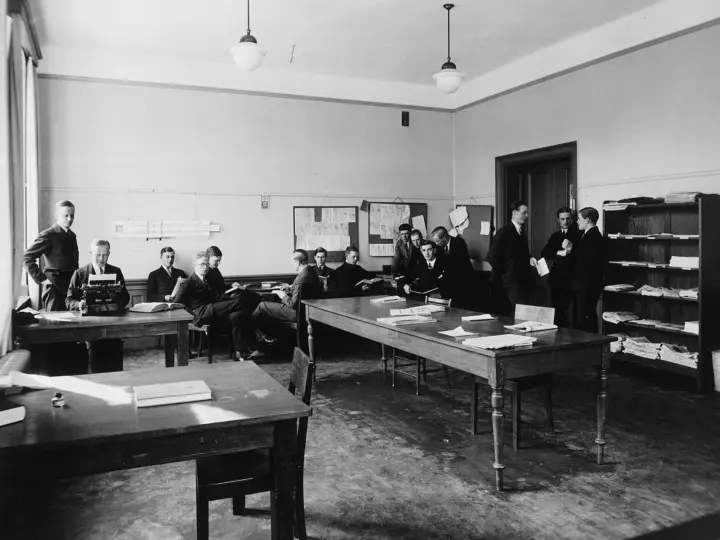
Following the recruitment of leading faculty, accompanied by support from the University of Gothenburg in the form of additional teaching resources and from the City of Gothenburg in the form of premises, the School quickly justified its existence – and so the institution grew and progressed.
After being based temporarily at the University of Gothenburg, in 1925 the School moved to Gamla Handels at Läroverksgatan 1. However, it soon outgrew these premises and plans for a separate new building began to take shape. The doors of the new facility at Vasagatan 3 opened on 24 October 1952.
The 1960s saw increased pressure on Sweden’s universities to give academic education a more professional focus. As part of this drive, studies in business and economics were also introduced by the universities, alongside the business schools. By July 1971, all the business and economic studies in Gothenburg had merged into one programme at the University of Gothenburg, and the School ceased to exist.
During the 1970s, business and economic studies were open to all and demand was met through subject-dominated mass education. In 1977, restricted admission was reintroduced, but 500 students were still enrolled each year onto the general and international business and economics programmes. At the same time, competition from new university colleges and other universities was beginning to increase.
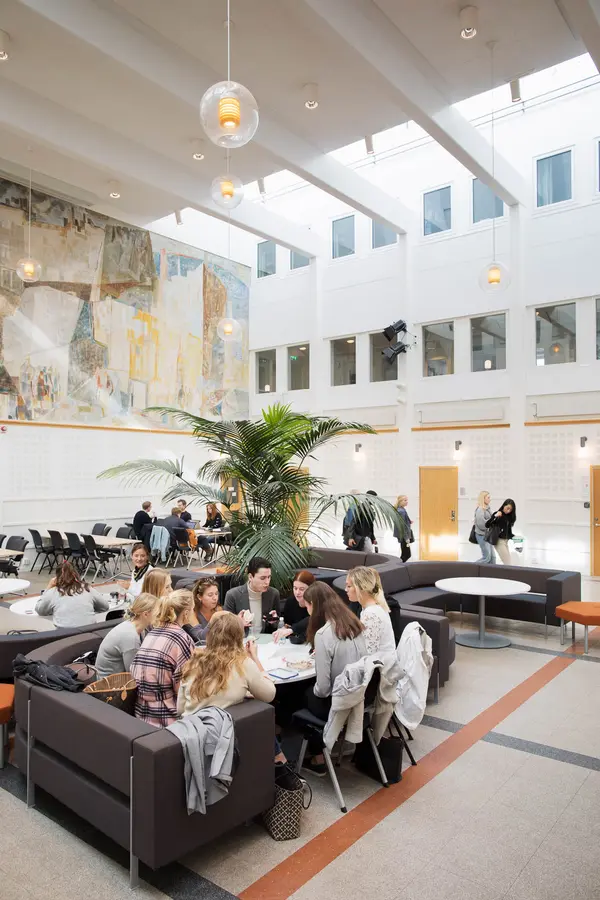
The large number of students also led to dissatisfaction with the quality of the education. As a result, the School of Business, Economics and Law was resurrected in 1986, now as a faculty within the University of Gothenburg. By this time the premises had definitely become too small. The 1952 building was designed for 700 students, but by the mid-1980s the School had around 4,000. The new building at Vasagatan 1 enabled most of the School’s departments to be gathered in the same location. The inauguration of the new premises in September 1995 marked the start of a new era for the School of Business, Economics and Law.