

Research team
- Jan Bachmann
- Benard Musembi
Cooperation partners
- Prof. Kennedy Mkutu, United States International University Africa, Nairobi
- Dr Michael Owiso, Maseno University, Kenya
Project activities
Our recent project activities are listed in the drop down menu below.


Publications
The research has resulted in both scientific articles and policy reports, listed in the dropdown menu below.

Background
In the vivid discussion on resources and minerals, sand is a late entry. The latter is surprising given that conditions of mining and trade of sand in rapidly urbanizing contexts have yielded a political economy premised upon exploitation and violence across the global South. It’s time to put those contestations on the map of critical inquiry.
Sand is the pivotal but under-acknowledged ingredient of modernity. Amenities that facilitate mobility and basic means of subsistence—roads, housing—are made of sand. Yet, sand is often taken for granted and, moreover, perceived as abundant. Global demand for sand, driven by extensive urbanization and large connectivity projects, has been skyrocketing to the extent that ecosystems such as rivers, lakes and sand-bearing landscapes are exploited at an unimaginable scale. The world consumes around 50 billion tons sand, mainly for the production of concrete, annually. Unsurprisingly, natural replenishment of sediment does not compensate for current the rate of extraction.
Accordingly, UNEP has called ill-regulated sand harvesting one of the most serious sustainability issues of the 21st century. The growing demand has turned this “development resource” into a lucrative business of extraction with violent conflict, environmental devastation and immense profits for the few as its core features. East Africa, as one of the fastest urbanizing regions on the planet, has seen its share of adverse social and environmental consequences of uncontrolled sand mining.
What is at stake?
While the harvesting of sand constitutes a livelihood for tens of thousands youths across Kenya and Uganda, mainly where alternative means of income are limited, unregulated harvesting depletes ecosystems and puts other livelihoods at risk. Furthermore, the astonishing appetite for sand in urban centres makes investment in the sand business a profitable endeavour for the already powerful. In other words, widespread ill-regulated extraction has shown its adverse social and environmental effects affecting communities across the two countries.
What are our cases?
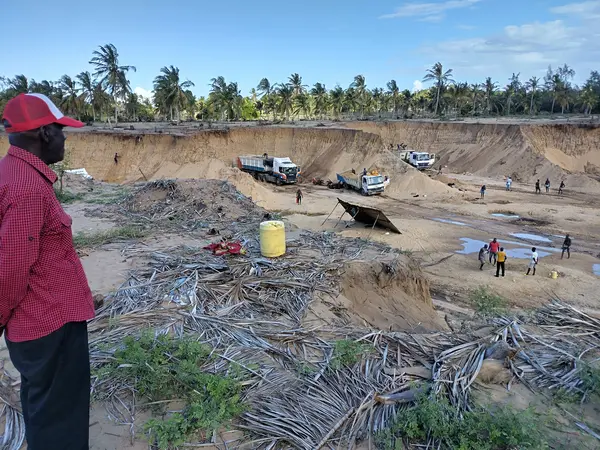
Our research teams, consisting of researchers from USIU, Maseno University as well as the School of Global Studies, collect data across Kenya and Uganda. After initial scoping missions carried out in 2022, fieldwork takes place 2023 and 2024 in the Kenyan counties of Makueni, Machakos, Kajiado, Taita Taveta, Kwale, Narok, Kilifi and Homabay. Work in Uganda takes place around the major harvesting sites at Lwera wetlands as well as along Lake Victoria.
Research aims and question
The aim of the project is to map disputes emerging in the context of sand-mining and trade in East Africa and to create general awareness for the scope of the problem. The project asks how dynamics of sand extraction and trade shape and are shaped by larger political constellations on the local as well as national level.
How do we go about answering them?
We trace economic, environmental and social issues emerging around resource extraction and along the sand value chain at major mining sites in 8 different counties in Kenya and two larger sites in Uganda. We trace those dynamics in two ways: bottom up from mines to markets and top-down from sites of demand (such as large housing or infrastructure projects) back to the sources of sand. The former allows for comprehensive scoping of mine-specific issues in a variety of areas; the latter may point us to temporary sites of extraction that mushroom in the context of large infrastructure projects.
Method(-s)
The project is premised upon extensive field research both at mining sites as well as along the value chain of sand. At the first stage, the research teams zooms in on identifying disputes at the sites of extraction, by interviewing loaders, communities, brokers and local authorities. At the second stage, data collection focuses on dynamics along the value chains. The variety of sites (scale, ecosystem, contestations, two countries) allows for a comparative approach to sand extraction. The findings will be shared and discussed at stakeholder meetings both at selected sites of research and at the national level. We furthermore collaborate with Natural Justice who will develop an application that makes it possible for communities across the country to register emergent issues in relation to resource extraction. In addition, we work together with Environmental Africa who sensitize local journalists and researchers on new ways to report issues related to natural resources.

