Department of Biological and Environmental Sciences
We investigate how fish are adapted to their environment and how they respond physiologically and behaviourally to changes in their environment. Our main focus is how rising temperature affects fish and other aquatic ectothermic animals, and how acclimation and adaptation may mitigate some of the impacts.
Climate change poses a severe threat to global biodiversity, and aquatic ecosystems are particularly vulnerable.
In our research group, we investigate how rising temperatures influence the physiology and behavior of fish. Our work is set against the backdrop of ongoing climate warming, with the goal of understanding how fish populations may respond - through physiological acclimation, evolutionary adaptation, declines in performance, or death.
Below, we highlight some of our key research themes and selected publications.
Thermal acclimation in ectothermic animals is the process of adjusting biochemistry, physiology, morphology, and behaviour to altered body temperature. Often, these modifications serve to counter the direct effects of temperature on biological rates and macromolecular functioning. For example, we have shown that domesticated zebrafish (Danio rerio) lines have lost plasticity compared with wild zebrafish (https://www.pnas.org/doi/abs/10.1073/pnas.2201919119).
We additionally study the dynamics and mechanisms of thermal acclimation in many marine fish and invertebrate species. Our recent book chapter covers some of the main mechanisms behind thermal acclimation (Encyclopedia of Fish Physiology).
We use various strategies to investigate thermal adaptation. We have conducted two very large multi-year artificial selection experiments. These experiments on wild-caught zebrafish spanned up to eight generations and tens of thousands of individual fish.
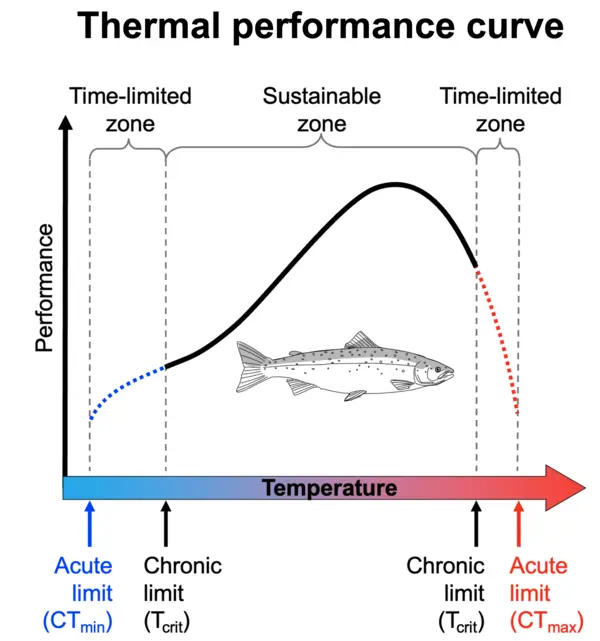
Our first evolution experiment, led by Rachael Morgan, tested if acute upper thermal tolerance (estimated by CTmax) and the plasticity of it (thermal acclimation) can evolve. We found that thermal tolerance did indeed evolve over only a seven generations, but the rate of evolution was very slow and the plasticity did not increase (https://www.pnas.org/doi/abs/10.1073/pnas.2011419117 ).
To understand what physiological mechanisms had changed from the artificial selection experiment, one large project led by Anna H Andreassen measured many performance and life-history traits. We found that contrary to predictions, oxygen transport and thermal sensitivity of metabolic rates were not altered. Likewise, it was unexpected that the thermal window increased through both higher CTmax and lower CTmin.
A recently finished large artificial selection experiment co-led by Robine Leeuwis and Lorena Silva Garay tested if thermal performance curves can diverge through adaptation to warmer or cooler water. The performance trait chosen was growth rate at optimal, cold, and warm temperatures. Results will be published soon.
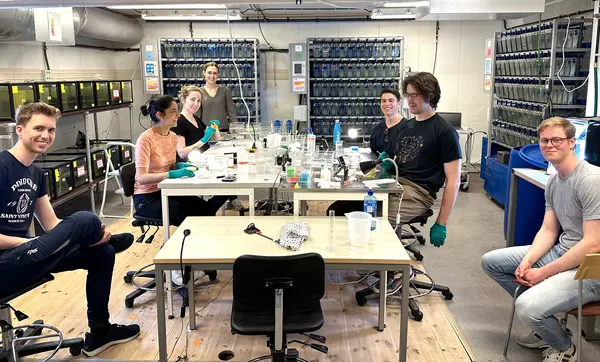
Many people are needed for large artificial selection experiments, here the team is measuring and photographing thousands of zebrafish.
The upper thermal limits of fishes have been studied for a very long time (e.g., Davy J. Some observations on the vitality of fishes as tested by increase in temperature. Rep Brit Ass Adv Sci 32: 125, 1862). Despite this, our understanding of the physiological mechanisms determining the upper limits is limited. Our recent review led by Rasmus Ern (PHYSIOLOGY) covers this topic in detail.
We have studied if the brain is a main organ limiting the thermal tolerance of fish. In transgenic zebrafish larvae, we found that it was a gradual decline in brain function when approaching thermal limits that appeared to lead to loss of response, and this decline was oxygen limited (https://www.pnas.org/doi/abs/10.1073/pnas.2207052119).
We have also studied the dynamics of thermal tolerance and found species and life-stage differences. Projects led by Jeremy De Bonville and Moa Metz have shown very rapid thermal acclimation (also called heat hardening) that can occur already three hours after a heat shock.
The role of oxygen in limiting thermal tolerance and performance of ectothermic water breathers (the OCLTT hypothesis) has been a long-standing debate in ecophysiology (LINK1, 2, 3, 4, 5). Together with a large international team, we recently tested if hyperoxia can increase acute upper thermal tolerance across many fish and crustacean species from several continents. We found that most species were oxygen-indifferent at normoxia, contrary to what the OCLTT hypothesis predicted.
World map and fish tested for oxygen limitation of thermal tolerance.
The performance of fishes can be modulated by temperature, and the decline in performance at higher temperatures is a main focus of the group. We have suggested that the decline in growth during warming may be explained by reduced appetite due to a voluntary protection of the aerobic scope after a meal (https://besjournals.onlinelibrary.wiley.com/doi/full/10.1111/1365-2435.13811).
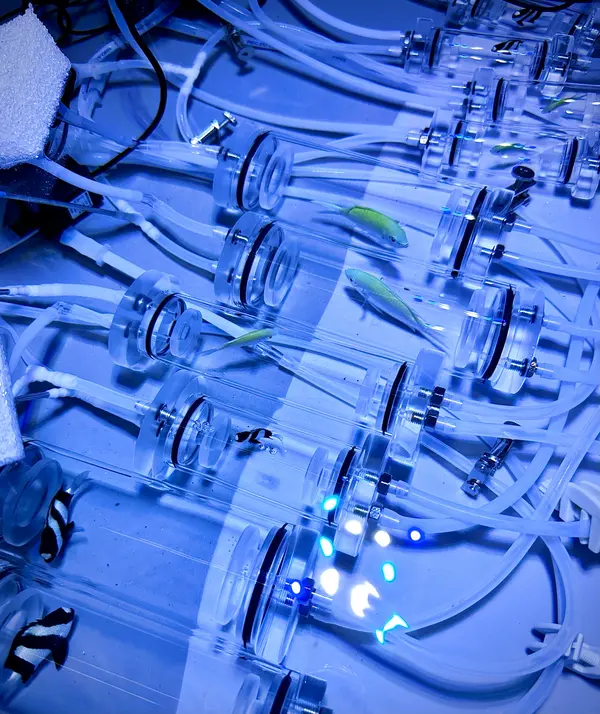
Coral reef fish in respirometers for metabolic rate measurements.
How swim performance and aerobic scope is affected by warming and how this is modulated by water oxygen level is under investigation by Emily Lechner.
Most of our work is on whole animal physiology but one project led by Leon Pfeuffer uses organ baths and another project led by Mafalda Tomás is using cell lines. For example, we are investigating how thermal tolerance and acclimation are controlled at a cellular level. More to come.
The referenced media source is missing and needs to be re-embedded.
We have investigated how zebrafish live in the wild, and our lab has unique lines of wild-caught zebrafish from northern india.
For some research questions, modifying a genetic pathway can be a direct way of investigating its role. This is now quite accessible through CRISPR modifications. We knocked out the heat shock response system in zebrafish to investigate its role in thermal tolerance and thermal acclimation. This work is ongoing, led by Moa Metz.
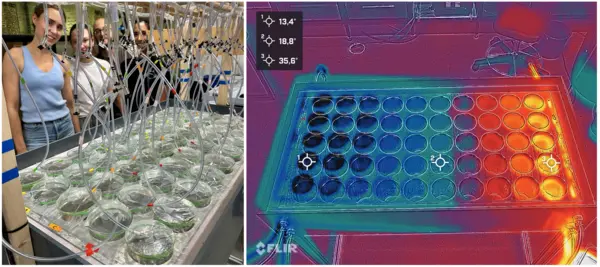
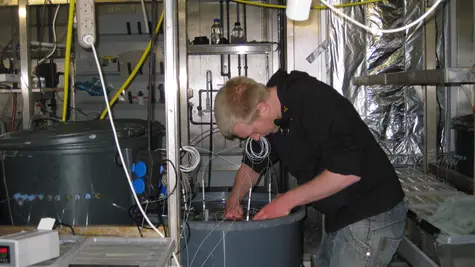
Early life stages of fishes have been suggested in a disputed meta-analysis to be the most vulnerable to the impacts of warming. We are therefore investigating if this pattern holds true through empirical studies on fish embryos. We use various ramping and static thermal exposures in many fish species in projects led by collaborator Zara Cowan and postdoc Patrice Pottier. One excellent tool used by Lorena Silva is the thermal gradient table (Figure) that maintains ten different temperatures and five replicates per temperature.
The thermal gradient table with Moa, Emily, Leon and Lorena. To the right is an infra-red view of the thermal gradient, covering temperatures from 13 to 35°C.
Elevated water CO2 levels have been suggested to cause dramatic behavioural effects such as a reversal of predator avoidance into strong attraction to predators. In a large multi-year replication effort, we showed those effects to be non-replicable (https://www.nature.com/articles/s41586-019-1903-y).
Aquatic hypoxia is a growing problem in both freshwater systems and the oceans, and warming surface waters can increase stratification further. We investigate how fish performance is impacted by hypoxia. In a collaboration with the University in Bergen, we are testing how coral reef fishes cope with fluctuating oxygen levels at night on Moorea (LINK).
Hyperoxia, when oxygen levels are above 100% saturation, can occur during daytime when waters warm and photosynthesis is high, with largely unknown effects on fishes. We use hyperoxic water in various experiments to test if hyperoxia can alleviate oxygen limitation and therefore increase thermal tolerance or thermal performance in fishes.
Our group is interested in how to ensure our work is solid and replicable. Over the past decade, we have witnessed several instances of poor science and outright fraud. These experiences have made us highly motivated to improve the scientific practices in our field.
As experimental biologists, we find that specific methods and tools that we need don’t exist. Therefore, we have published various method development articles and best-practices guideline reviews:
Machine vision for automated landmarking, led by Henning Husmo. Link
Thermal tolerance measurements in fish, best-practices review. Link
Regulation of water oxygen levels, led by Rasmus Ern. Link
Thermal tolerance measurements in embryos, led by Zara Cowa. Link
Rasmus Ern, Marie Skłodowska Curie postdoc Rasmus Ern is interested in the physiological and organismal responses of fish and crustacean species to changes in water temperature, oxygen, salinity, and acidity. In the Jutfelt Lab, Rasmus studies potential links between the metabolic and behavioural responses of zebrafish to changes in water temperature and oxygen.
Robin Leeuwis, Postdoc Robin is a fish physiologist studying the effects of water temperature and oxygen levels on physiological processes such as cardiorespiratory and immune function. One of her current projects revolves around multi-generational adaptation to warming waters.
Patrice Pottier, Postdoc Patrice is studying the thermal tolerance of early life stages in fish with the aim of understanding of global climate change vulnerabilities.
Lorena Silva Garay, PhD Candidate Lorena is a PhD candidate with a background in elasmobranch ecophysiology and feeding ecology. For her PhD, she is investigating how fish adapt to warming across generations using artificial selection. She is also exploring the mechanisms that shape upper thermal tolerance, focusing on how stressors like temperature and oxygen during early-life can alter development and thermal tolerance into adulthood.
Moa Metz, PhD Candidate Moa has a background in molecular evolution and ecology, and in her PhD project, she studies cellular mechanisms behind thermal tolerance in fish such as the production of heat shock proteins.
Leon Pfeufer, PhD Candidate Leon is a PhD candidate with a background in invertebrate ecophysiology. Now, he is studying thermal physiology in fish. In particular, he investigates what physiological mechanism(s) limits thermal tolerance and determines thermal performance.
Emily Lechner, PhD Candidate Emily is a fish physiologist studying the effects of water temperature and oxygen levels on physiological processes, such as metabolism and oxygen consumption. One of her current projects focuses on creating aerobic scope profiles across a variety of oxygen levels for both zebrafish and rainbow trout. A future project will be on the long-term adaptation of Icelandic three-spined sticklebacks to geo-thermally heated lakes. Her background focuses on the eco-physiology of salmonids, in respect to climate change and the effects on early life stages.
Mafalda Tomás, PhD Candidate Mafalda’s background is in ecology, as well as animal behavior and welfare. Her research now centers on fish physiology, with a focus on understanding how elevated temperatures impact the early life stages of fish. She is exploring potential trade-offs and investigating whether these stages show capacity for acclimation to warming conditions.
Eline Rypdal, Research Technician, Trondheim Eline is head of the animal facilities, keeping our zebrafish lines thriving. She is also involved in experiments and data analysis. Eline holds a master's degree in ecology, and has previously been conducting fieldwork focusing on seabirds.
Henning Husmo Kristiansen Henning is a biologist turned computer scientist. He is involved in several fish experiments and is also developing machine learning apps for fish measurements and fish tracking.
Pierre Renaud, Erasmus MSc student Pierre is running various experiments on the effects of temperature on rainbow trout organs and cell lines, testing thermal tolerance and thermal acclimation.
Justine Benezis, Erasmus MSc student Justine is conducting an experiment testing the effects of genetic knockout of the heat shock response in zebrafish.
Signe Løvmo, PhD candidate Signe investigates intestinal function in salmonids. Jutfelt is co-supervisor, Rolf Erik Olsen is main supervisor.
Dr Zara-Louise Cowan, Researcher Zara is an ecologist with a background in mainly aquatic animal behaviour. Her current topics are thermal adaptation and climate change vulnerability across life stages in fish. Zara is now a Researcher and P.I. at the University of Gothenburg, Kristineberg Center.
Dr Anna H. Andreassen, PhD Anna is studying the mechanisms of thermal tolerance with a focus on how phenotypic traits vary with selection for thermal tolerance, and the role of the central nervous system and cardiac capacity during heat challenges. Anna is currently a postdoc at the University of Copenhagen.
Mette Finnøen, PhD Candidate Mette is studying the behavioural thermal plasticity of zebrafish, which includes the within- and between individual variation in behaviour expressed at various temperatures, and how these behaviours vary together (covariance).
Hanna Scheuffele, PhD Hanna is investigating the physiological mechanisms underlying the ‘temperature size rule’ phenomenon, whereby aquatic organisms like fishes cannot grow as large in warmer waters. Co-supervised with Tim Clark at Deakin University.
Dr Josefin Sundin, Postdoc and Researcher Josefins project investigated the effects of ocean acidification and other environmental stressors on fish behaviour and reproduction. She currently holds a permanent position as researcher at the Department of Aquatic Resources, The Swedish University of Agricultural Sciences, Sweden.
Dr Jeff Clements, Marie-Skłodowska Curie Postdoc Jeffs project took a comparative approach to study the effects of multiple global change stressors on the behaviour of fishes and invertebrates by integrating empirical laboratory studies with synthesis science (meta-analyses). He now has a permanent position as Research Scientist at the Aquaculture and Coastal Ecosystems Section, Fisheries and Oceans Canada, Canada.
Dr Archana Golla, PhD (Co-supervised by Jutfelt) Archana is a PhD candidate investigating behavior, neurophysiology and stress in fish. Jutfelt is co-supervisor, Florence Kermen is main supervisor.
Dr Laura Vossen (Co-supervised by Jutfelt) Laura's PhD project explored how elevated levels of dissolved CO2 (ocean acidification) and low concentrations of the pharmaceutical oxazepam affect the neurophysiology and behaviour of fish. Main supervisor was Svante Winberg. Laura is currently a Post-Doc at the Swedish University of Agricultural Sciences, Uppsala, Sweden.
Dr Arianna Cocco (Co-supervised by Jutfelt) Ariannas PhD project revolved around the GABA system in fish. Arianna is currently a Senior research engineer at the Department of Medical Biochemistry and Microbiology at Uppsala University, Sweden.
Dr Andreas Ekström, PhD In his PhD project (2012-2017), Andreas studied the relationship between cardiovascular performance and thermal tolerance in fish (Co-supervised by Jutfelt, main supervisor Erik Sandblom). Andreas is currently working as a researcher at the University of Gothenburg.
Dr Lars Niklasson, PhD PhD in 2013 (Co-supervised by Jutfelt, main supervisor Kristina Snuttan Sundell).
Miriam Dørum, Research technician Miriam was head of the animal facilities, keeping our zebrafish lines thriving. She was also involved in experiments and data analysis.
Adriana de Aguiar Martins, Research technician Adriana was head of the animal facilities, keeping our zebrafish lines thriving. She was also involved in experiments and data analysis.
Jonas Arntsen, MSc Jonas tested how selecting for higher and lower critical thermal maxima in zebrafish affected their thermal preference.
Mons Lien, MSc student Mons is a 2nd year master student, writing his thesis on swim speed and metabolic rate in zebrafish.
Anders Meyer, MSc Anders did a two-year MSc project on the effects of oxygen and temperature on growth and appetite in fish.
Sondre Kristenstuen, MSc Sondre did a two-years project on how oxygen and temperature affect growth and appetite in fish, with focus on activity level and swim performance.
Marie Reiersen, MSc Marie is a LUR MSc student doing a project on how thermal acclimation and oxygen affect thermal tolerance (CTmax) in fish.
Sandra Steen, MSc Sandra studied the effects of high intensity interval training in humans. Jutfelt was co-supervisor, Trine Moholdt was main supervisor.
Eirik Åsheim, MSc student Eirik did a two-year project on the thermal performance and thermal tolerance of wild-caught zebrafish, in relation to environmental factors. Parts of that work is published. Eirik did his PhD with Craig Primmer at the University of Helsinki, Finland.
Kristin Espolin Johnson, MSc student Kristin investigated how VO2 affects cardiovascular risk in older adult humans. Jutfelt was co-supervisor, main supervisor Dorthe Stensvold.
Hanne Margrethe Hildrum, MSc student Hanne did a one-year MSc project on thermal tolerance using CTmax and CTmintests, combined with results from behaviour experiments, on zebrafish.
Tine Brusevold, MSc student Tine did a MSc project studying differences in plasticity in behavioural traits in wild caught zebrafish lines exposed to different thermal treatments. Co supervised with Jon Wright.
Gunnar Dresler, MSc student Gunnar did a two-year project on the thermal physiology and plasticity of wild-caught zebrafish.
Leon Green, MSc student Leon did a MSc project on how ocean acidification may affect catsharks. Leon has recently finished his PhD in evolutionary ecology of invasive fishes under Lotta Kvarmeno at the University of Gothenburg. He is now working as an assistant professor on marine invasive species.
Maria Hedgärde, MSc student Maria did a project investigating if cod are affected by elevated CO2 levels resulting in two papers 1,2.
Roman Motyka Roman did a MSc project on how ocean acidification may temperate fishes.
Violetta García Muñoz (Spain) Violetta is an Erasmus student from the University of Valencia who helped with various zebrafish experiments in 2021-2022 during an internship in our lab.
Nathalie Folliard (France) Nathalie conducted an experiment testing how heart rate in various species of crabs is affected by temperature. 2021-2022.
Margarita Villalonga Roca de Togores (Spain) Marga is a Spanish Erasmus student who conducted various zebrafish experiments during 2019.
Mireia Silvestre (Spain) Mireia is a Spanish Erasmus student who conducted various zebrafish experiments during 2018.
Marc Vendrell (Spain) Marc is a Spanish Erasmus student who conducted various zebrafish experiments during 2017.
Daphne Cortese Daphne, together with Amelia Munson, ran a large experiment on temperature and fish behaviour in our lab.
Amelia Munson Amelia, together with Daphne Cortese, ran a large experiment on temperature and fish behaviour in our lab.
Brenna Stanford Brenna stayed with our lab in Trondheim while finishing up her PhD at the University of Calgary.
Jeremy de Bonville Jay is a fish physiologist studying the impacts of warming and parasites on fish. Jay is collaborating on several projects and has been running experiments in our lab during 2022.
Daniel Sadler Daniel is a fish ecologist who studies fish genomics, climate change, and all things fish. He ran a long temperature and hypoxia experiment at NTNU during 2022.
Dr Joanna Miest Joanna collaborates on a project on fish olfaction and chemical ecology, and on a project testing how thermal evolutionary history affects thermal acclimation capacity.
Dr Adam Gouraguine Adam collaborated on a project for improving two-current choice flume research.
Davide Spatafora Davide tested how thermal acclimation affects swim performance in zebrafish.
Adrian Loh Adrian collaborates on a project testing how thermal evolutionary history affects thermal acclimation capacity, with a focus on gene expression patterns.
Josefin Sundin, SLU Josefin is a behavioural ecologist and all-around fish expert. She collaborates on many projects in fish physiology and behaviour.
Zara Cowan, University of Gothenburg Zara investigates climate change vulnerability across life stages in fish and collaborates on various projects and co-supervision of students.
Timothy Clark, Deakin University Tim is a collaborator on many projects on fish ecophysiology, as well as on various reproducibility efforts.
Sandra Binning, University of Montreal Sandra is a behavioural ecologist collaborating on various fish behavior projects (and zombie science).
Graham Raby, University of Windsor Graham collaborates on fish behavior, ocean acidification, and fishing stress.
Tamzin Blewett, University of Alberta Tamzin is a physiologist and toxicologist who examines the interactions between aquatic animals and the environment. She is a collaborator on various fish and crab physiology projects.
Ben Speers-Roesch, University of New Brunswick Ben is a fish physiologist working on thermal biology
Tommy Norin, DTU Tommy is a fish physiologist interested in scaling of metabolic rate and how fish physiology is affected by various factors.
Dominique Roche, Carleton University Dom is a behavioural ecologist collaborating on various behavior projects, as well as reproducibility initiatives.
The FIN club is an unruly group of aquatic physiologists who organize annual research trips and workshops.
FIN club team The FIN club is an unruly group of aquatic physiologists who organize annual research trips and workshops.
Christian Jørgensen, University of Bergen Christian is a collaborator on the Hypoxia on tropical coral reefs project funded by the RCN.
Suzanne Mills, École Pratique des Hautes Études Moorea Suzie is a collaborator on projects testing the effect of hypoxia and hyperoxia on coral reef fishes in Moorea.
Joanna Miest Joanna collaborates on a project on fish olfaction and chemical ecology, and on a project investigating cellular responses to warming.
Florence Kermen, University of Copenhagen The Kermen lab investigates behavior, neurophysiology and stress in fish.
Rolf Erik Olsen, NTNU Rolf Erik collaborates on gastrointestinal and thermal physiology projects, as well as a fish microplastics project.
Sam Dupont, University of Gothenburg Sam is a collaborator on ocean acidification experiments at Kristineberg.
Svante Winberg, Uppsala University, Professor Svante Winberg on the neural causes of the behavioural disturbances seen in some fish exposed to elevated CO2 levels. Svante is the main supervisor for Laura and Arianna.
Malin Rosengren, University of Gothenburg Malin collaborates on fish physiology and personality projects.
Erik Sandblom, University of Gothenburg Erik Sandblom is a collaborator on fish physiology and thermal biology.
Michael Axelsson, University of Gothenburg Professor Michael Axelsson is a leading expert on circulatory physiology and in vivo surgical techniques in ectothermic vertebrates.
Catriona Clemmesen, GEOMAR Helmholtz Centre, Kiel Collaborator on the impacts of ocean acidification on fish larvae.
Michael Sswat, GEOMAR Helmholtz Centre, Kiel Collaborator on the impacts of ocean acidification on fish larvae.
Martina Stiasny, Institute for Marine Research, Bergen Collaborator on the impacts of ocean acidification on fish larvae.