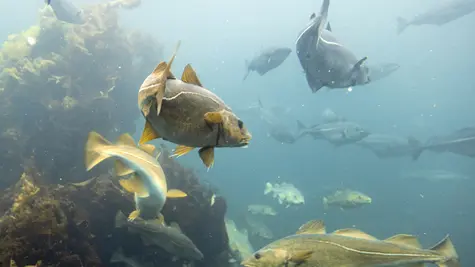
Only a few marine species have managed to colonize the Baltic Sea. In this article, the authors try to understand how one of these species, the European plaice, managed to cross the environmental boundary and successfully establish populations within the Baltic Sea.
Enigmatic zone
The transition zone between the North Sea and the Baltic Sea is an enigmatic place for marine biologists interested in evolution. The Baltic Sea has a recent history, being connected to the ocean only 8,000 year ago, and numerous environmental factors, notably the salinity, varies rapidly in the area.
"We found that the European plaice adapted to the Baltic Sea conditions thanks to the presence of two “supergenes” within their genome. These supergenes are likely the result of chromosomal inversions in two of the Plaice’s chromosomes. Interestingly, we estimated that these supergenes started to evolve roughly 200,000 years ago, which by far exceed the age of the Baltic Sea itself", says Alan Le Moan.
Read the article: Evolution at two time frames: ancient structural variants involved in post-glacial divergence of the European plaice (Pleuronectes platessa)
Authors: Alan Le Moan, Dorte Bekkevold & Jakob Hemmer-Hansen
Published in Heredity, February 2021