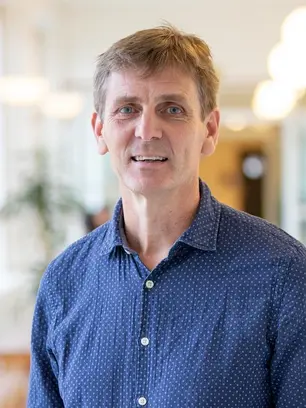
“The EU Emissions Trading System has demonstrated remarkable effectiveness in reducing greenhouse gas emissions. Inspired by this success, we aim to explore similar approaches for chemicals. By addressing gaps in current regulations, our research seeks to inform EU chemical policy reviews and support upcoming circular economy legislation,” said project leader Daniel Slunge, Director of FRAM – the Centre for Future Chemical Risk Assessment and Management, at the University of Gothenburg.
Sustainable transition
Slunge, together with Thomas Sterner and Thomas Backhaus (University of Gothenburg and RWTH Aachen University), also researchers at FRAM, as well as Marlene Ågerstrand and Natasja Börjeson from Stockholm University, and Matti Vainio from the University of Helsinki, will develop proposals for market-based instruments inspired by successful models, such as the EU Emissions Trading System.
“Our ambition is to drive industrial innovation that accelerates the transition to safer chemicals and a toxic-free circular economy. Ultimately, this can enhance both public health and environmental outcomes across Europe,” said Slunge.
Safer chemicals
The project will utilize three case studies to test and refine the policy instruments: substances of very high concern (SVHCs) on the EU candidate list, PFAS, and hazardous chemicals in plastics. The researchers will also collaborate in so-called "Policy Labs" with industry, policymakers, and civil society, where the aim is to develop solutions that are both scientifically robust and practically feasible.
Fact
The research project ”INCENTIVIZE: Transferable quotas, fees or taxes for a less toxic circular economy” has received funds – 6 million SEK– by the research foundation Mistra within the call Mistra Utmana.
INCENTIVIZE is led by Daniel Slunge, Environment for Development, at the University of Gothenburg (GU), in collaboration with:
- Thomas Backhaus, GU & RWTH Aachen University, Germany
- Marlene Ågerstrand, Stockholm University
- Natasja Börjeson, Stockholm University
- Thomas Sterner, University of Gothenburg
- Matti Vainio, University of Helsinki, Finland
Mistra Utmana, which funds the project, aims to enable bold and innovative research projects that address significant and complex sustainability challenges. Projects are encouraged to propose groundbreaking ideas that challenge conventional perspectives, with the goal of contributing to a sustainable societal transformation.
The expert panel for the call highlighted the project's high scientific quality and its potential for significant impact on both policy and society. For more information about the project and FRAM’s work, visit FRAM's website.