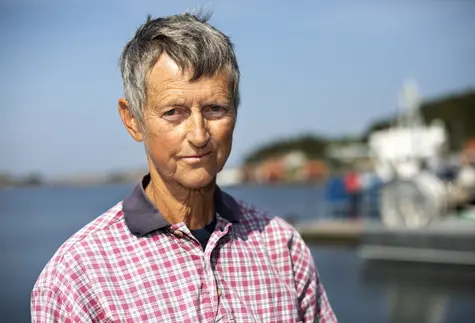
Molecular Ecology is the internationally leading scientific journal in the field of molecular ecology and Kerstin Johannesson now belongs to a group of very distinguished scientists who have received the award.
“It’s a very, very big honour that the jury thinks I belong to this group,” says Kerstin Johannesson, professor in marine ecology, Department of Marine Sciences, University of Gothenburg.
First to use genetic methods
Molecular ecology is research in the border between ecology and genetics. The research area works mainly with species in nature, and not with so-called model organisms in labs, such as banana flies. It’s a fairly new, but very expansive area.
“I belong to the first generation of researchers that used genetic methods to tackle classical questions in evolutionary biology and evolutionary ecology, questions that Darwin had already asked 100 years earlier. For example, how organisms adapt to their environment, how new species develop, what happens in hybrid zones,” says Kerstin Johannesson.
The award ceremony will take place this autumn in connection with the Centre for Marine Evolution Biology's (CeMEB) October meeting at Tjärnö Marina Laboratory.
Link to the news item on Molecular Ecology
From the award statement Molecular Ecology Prize 2022
Trained as a marine ecologist, her research over the past 40 years has focussed on understanding how marine organisms become adapted to their environment.
Towards this goal, she performed pioneering molecular ecology work that fully integrated ecological and molecular approaches to study the sea snail, Littorina saxatilis, which she developed into a model species.
Her work has inspired numerous researchers across Europe to also use Littorina as an ideal model to study the ‘tug of war’ between evolutionary forces that have driven ecotypic divergence across different habitats of littoral zones.