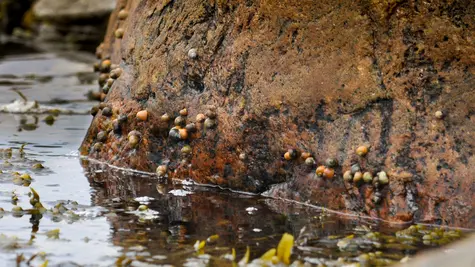
“Many people have probably seen these snail a thousand times, but don't know much about them or what's special about them," says Luisa Kumpitsch, PhD student and researcher at the Department of Marine Sciences.
She works in the research project called “WinkleWatch” which spans eight countries, including Sweden. It focuses on the rough periwinkle (Littorina saxatilis), a species common along the Swedish west coast and in many other countries in Europe and North America.

Researchers are now enlisting the help of the public to find out more about the small snails.
Everyone can take part in the research
"We want help with photographing and sending in pictures of the snails. We have very good descriptions online of what they look like and where to look for them,” says Luisa Kumpitsch,.
Using the iNaturalist app, those who want to help can take and upload photos with their mobile phones.
“Then we can access the photos and study the colour variations of the shells,” says Luisa Kumpitsch.
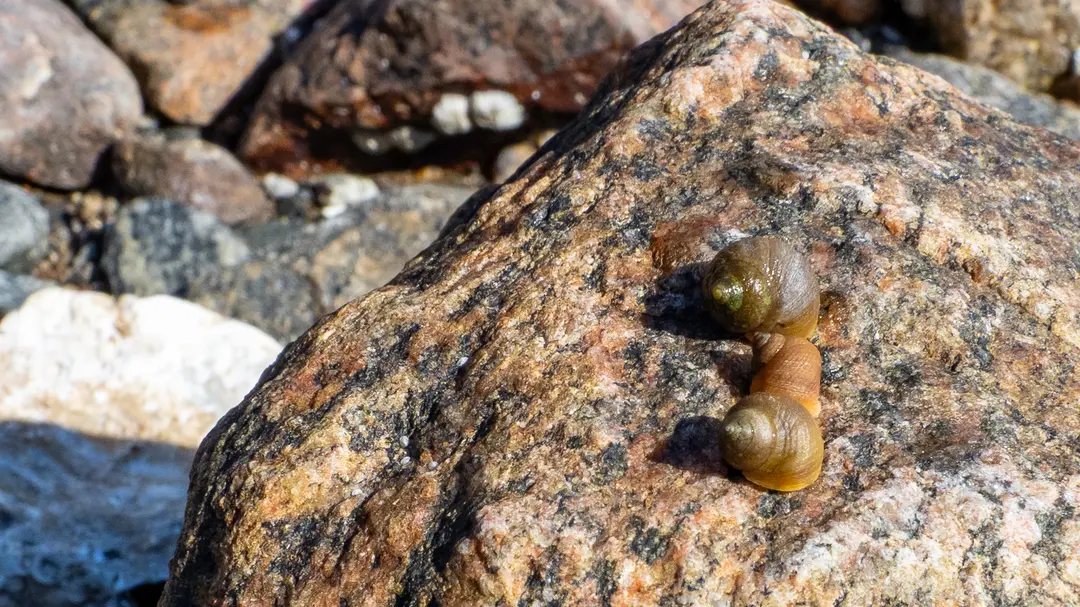
The rough periwinkle rarely grows longer than 15 mm, is often yellow or orange in colour in Sweden, has a tall, pointy spire and indented, sharper whorls compared to its larger and more bulky cousin, the common periwinkle (Littorina littorea). The latter is often grey, brown or black in colour, can grow much bigger than 15 mm, and has smooth whorls.
Periwinkles vary great in colour and pattern
Another distinctive feature in the rough perinwinkle is that the shell varies greatly in both colour and pattern. This puzzles the research community and is something the project aims to understand.
“They look really different in different countries, but also within countries. We don't really know why that is,” says Luisa Kumpitsch.
Do you have any theories?
“Sometimes they are the same colour as the rocks and stones they are found on, so it could be a protection against crabs and birds eating them."
Another theory is that it might have to do with temperature. Different colours absorb sunlight and heat in different ways and one colour might be an advantage in warmer countries like Portugal, while another colour is better for the snails in Sweden.

“The participants are welcome to suggest why they think the shells vary so much in colour,” says Luisa Kumpitsch.
Become a snail detective
As part of the research project, she will also lead several snail excursions for families, or any nature enthusiast, this summer. This is included in the summer program at Tjärnö Marine Laboratory.
“Here, the children learn about nature and biology, about how to find the snails, and then we go out on the beach and look.”
So you become a snail detective?
“Exactly. And then you help us study them, you learn about how we scientists work and you are part of an international research project. I think it will be super cool,” says Luisa Kumpitsch.

Rough periwinkle (Littorina saxatilis)
5 to 15 mm in size.
The shell can vary greatly in colour and pattern, but in Sweden the colour is often orange or yellow.
High, tall Spire (on the shell).
Indented whorls (unlike the common periwinkle which has softer whorls).
Gives birth to live young, unlike other periwinkle species, where the young have larval stages within egg masses or egg capsules.
Found mainly in northern Europe and North America.
Often found in or near the water along rocky and cliffy shores.
Belongs to the genus Littorina, small marine snails. Examples of other species in the genus found in Sweden are the common periwinkle (Littorina littorea), the flat periwinkle Littorina fabalis and Littorina obtusata.