

Marine research, oceanography and the technology on board a modern research vessel were on the timetable when students from Franklins gymnasium came aboard R/V Skagerak, as part of their Natural Science Specialisation course, in which they are focusing on oceanography.
For Skagerak Facility, school visits are an important part of its work to spark young people’s curiosity about the ocean, research, technology and future careers in marine science and shipping.
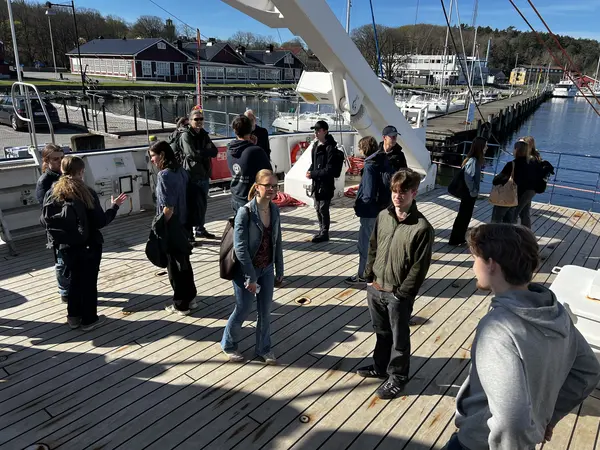
Axel McElhinney, 19, student at Franklins gymnasium
Why are you here today?
“We are here with our class to have a look at R/V Skagerak and see what you can do on board the vessel: what laboratories there are, how oceanography and different types of research at sea are carried out, what kinds of samples can be taken and what scientific studies can be done.”
What is it like to come on board?
“It was fantastic! It was really interesting to see what you can do as a researcher, but also as an engineer if you want to work on a vessel. We also got to see what kinds of experiments can be carried out in the laboratories on board.”
Could you imagine yourself working in an environment like this?
“Absolutely. I love science in general, so it would be an amazing experience if I got the chance.”
What does it mean that a research vessel like this is based in Gothenburg?
“It is great. Gothenburg is by the sea, and having a vessel like this so close to those of us who live here is really exciting! It is good to know that it exists.”
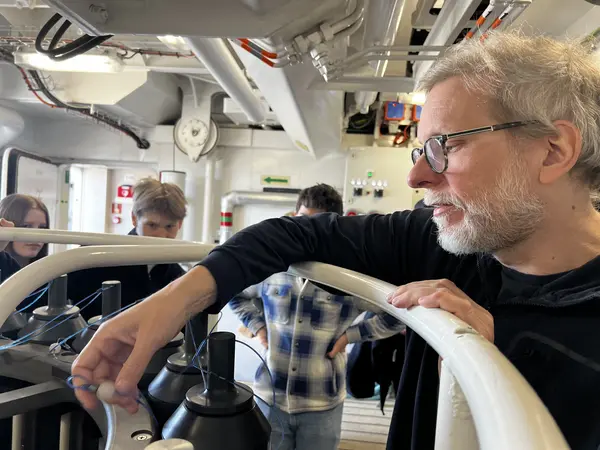
Olof Dahl, teacher at Franklins gymnasium
What is the background to this visit?
“The students are taking a course called Natural Science Specialisation, where we focus on oceanography. To make sure it is not only theoretical, I want them to see something for real. A real research vessel is quite exciting, and since it is here in Gothenburg, it is very easy for us to get here. Absolutely perfect!”
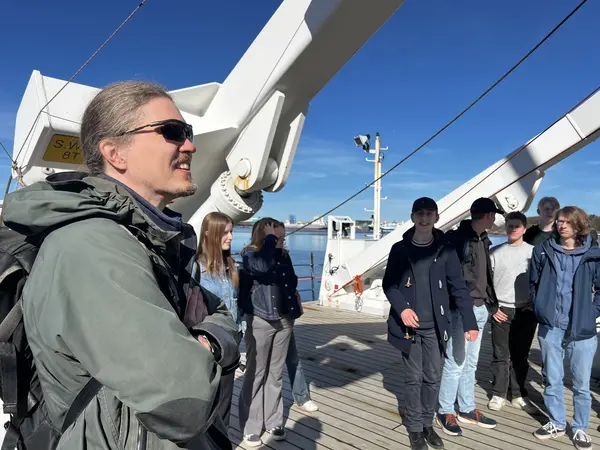
This is the third year you have brought students to R/V Skagerak. How do you use the visit in your teaching?
“We have gone through a lot of things beforehand, and then they get to see some of it in practice here. It may make it easier for them to believe that it actually exists. We have talked about measuring instruments, and now they get to see them in real life.”
What does the visit usually mean for the students?
“Many of them tend to be very pleased. The students get to see real things, and some become very inspired. Some start thinking about whether they might want to do something at sea or study something in this field.”
What does it mean to you as a teacher that the University of Gothenburg has this kind of research vessel?
“It is a prerequisite for being able to do many things. It is great fun to come here, and it is a different kind of study visit from what you can otherwise do.”
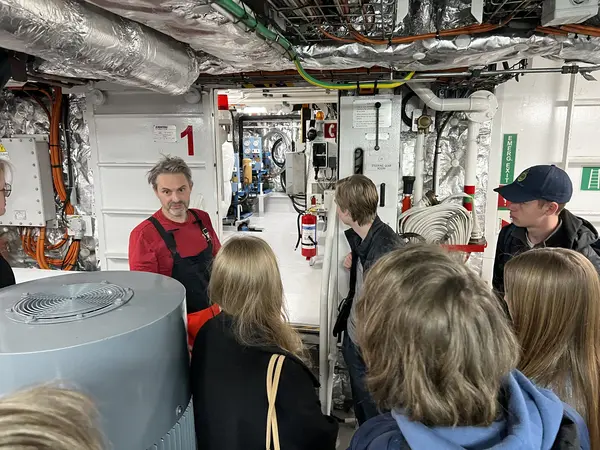
Nathanael Sprei, 18, student at Franklins gymnasium
What course are you taking?
“We are students at Franklins gymnasium and are taking a course in oceanography. It is basically physics, but in water.”

What was it like to come aboard R/V Skagerak?
“It was very interesting. We have looked a lot at statistics and how water is studied. It was great to see how it is actually done, where it is done, and to meet some of the people who work with it.”
Does it make a difference to see the research in real life?
“Yes, definitely. It is interesting when you see what actually happens and where it happens.”
Do you think a visit like this can influence young people?
“Definitely. It becomes so much more exciting when you get out of the classroom. It is not just about looking at statistics or studying a lot of maths; there is also a practical side to it — and it is really cool to experience that on board R/V Skagerak.”
Textt and photos: Agnes Faxén


